Challenge!

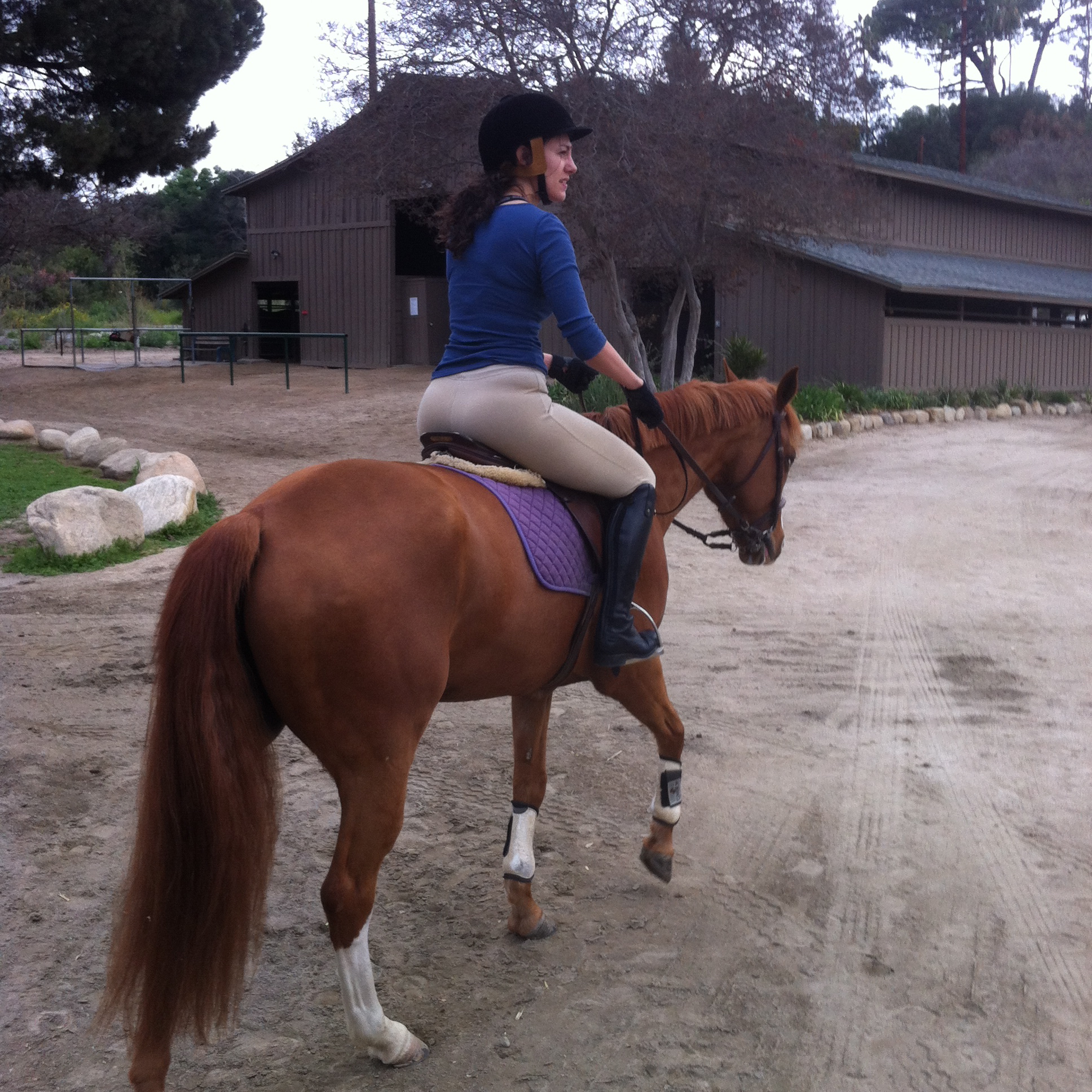
I rode Bella again today and we did a (for me) very challenging course. We were back in the Big Girl ring again and the jumps were on the higher end of my experience (2’6″-ish, I think, and one was an oxer!).

There were a few challenges with the course, but as seems to frequently be the case with me lately, they were mental rather than physical. My new training schedule seems to be working well, and I feel I’ve trimmed down and tightened up quite a bit. I do always feel a little bit rushed to warm up, especially today when I got to the barn a little later than planned. But even with a quick warm-up at the trot and canter, my muscles seem much more supple than they were even a month ago. I’m going to make it a point to get there a little earlier next time and have a thorough warm-up.

We dove right in with a low vertical on the diagonal to warm up with. I went to it with the confidence of last week’s realization that I have to stop being a control freak and just feel the rhythm more freely with my horse. We took our first two jumps very nicely and even got the flying change afterward, and I was feeling confident and ready for a challenge.

That’s why it felt especially clumsy when we did the course. Basically a figure-eight shaped design, we started on that same vertical on the diagonal (which had a weird approach through all the other jumps), then took the line containing the oxer on the other diagonal, then turned around and took a roll-top on first diagonal, then came over another vertical on the other diagonal again. That’s the best I can describe it; the jumps were haphazardly placed so there was a lot of negotiating obstacles to find the best approach.

My first time through felt pretty disaster-y. Even though Bella was more up and responsive than last week, we still didn’t quite have the right pace for the height of the jumps we were doing. We got in really, really deep to all of them and I was honestly surprised we even made it over some of the jumps. I owe that entirely to Bella, who kept her head and used her athleticism to rock far back on her hind legs and save both our necks.

I also can’t blame this entirely on our pace. I know I was focusing too much on the jumps themselves, looking down at them and anticipating them rather than looking up and through them. It’s new for me to be doing these more challenging jumps and it’s both exciting and daunting (even though I recently read this cute and helpful article on Horse Collaborative). So instead of doing the things my head is supposed to be doing, like counting strides and using its knowledge of how to get flying changes and take turns properly, it’s doing something like this: “Oh ok wow here’s the next jump. It’s high! Holy shit, this is awesome–wait no–god, can I do this? Yes, yes I can. Gotta move her up, let’s go, let’s go…oh, shit, where’s the spot?…aaaah we are in too deep are we gonna make it? Ok yes! Thank you, Bella! Phew. NEXT.”

In between my first and second round, I watched one of my classmates take a fall. She went into the line deep, got a little bounced out of the saddle going to the oxer, and then her horse helped her along by giving a tiny buck afterwards. She was not seriously injured, just a little bruised, but it was a hard-sounding thud when she hit the ground and that’s always terrifying. I had to talk myself down from starting to feel anxious before my next turn, which seemed easier than usual. But then when I went through the course I was still a bit distracted by the fall and wasn’t able to do it much better than my first time.

The third time through, I started to get it. The jumps started coming together better with a little more pace. I had to stop halfway through to re-organize, but that was because of trying to get the flying change in between. I pulled Bella down to the walk, caught my breath, and did the second half of the course in a way I was much more pleased with.

Our last time through was the best. It wasn’t perfect, but it was a vast improvement. We had a good rhythm and the spots came more easily. We only got a little deep on one of them, but it wasn’t disaster-y deep, it was just like a normal added stride that made it not perfectly smooth. I pretty much gave up on trying to get the flying changes by this point and just did simple ones so that I could entirely devote my attention to the course itself and do it well. Given one more go, I think I could have gotten it perfect, but that was a good one to stop on, employing the motto of riders everywhere, “Quit while you’re ahead.”

I was pleased with how the lesson went. It can be alluring to just stay in your comfort zone and feel like you’re doing everything well, but stretching myself and challenging myself is what I’ve wanted to do for so long. When I’m doing it I sometimes feel clumsy or foolish, but ultimately, I feel proud that I’m getting better, little by little. It was also nice to hear from my trainer that she knows she’s pushing me and that it’s tough, but that I’m doing really well.

I’m thinking of trying to go to two lessons a week instead of just the one. Hopefully that will speed up the improvement. The more jumps I get under me, the more confident I become.

 

Equestrian Fitness: Overtraining, Part 2

cliff

Last week I wrote about the destructive effects of overtraining. I recognized that I was pushing myself too hard and not allowing enough rest in between workouts and this was actually hampering my progress.

In my last post, I put together a new weekly schedule for working out 5 hours a week with scheduled rests. This is what that looked like:

Monday: rest

Tuesday: yoga class (1 hour)

Wednesday: calisthenics/leg and core toning (squats, lunges, crunches, etc) or upper body and core toning (planks, push-ups, crunches, etc)  at home (1 hour)

Thursday: rest

Friday: riding lesson (1 hour)

Saturday: cycling class/upper body weight machines (45 mins /15 mins=total 1 hour)

Sunday: treadmill intervals/lower body weight machines (30 mins / 30 mins= total 1 hour)

Well, none of that happened.

I was actually so shot from overtraining that I ended up taking the entire week off.

The body is so adaptable that it’s very easy to miss subtle signs, or to mischaracterize them. But there were things beyond “normal” tiredness that made me see that I needed a break. Like going up more than one flight of stairs made my thigh muscles feel as exhausted as doing several sets of squats.

So what did I do on my week off? Pretty much nothing. I did some stretching before bed, took some strolls around the park, but that was about it for physical activity. I also made some changes to how I’m eating, cutting sugar (almost) entirely out and adding more lean proteins and vegetables.

The surprising thing is that during that week off, I felt better than when I was working out. I mean “better” in the sense that my body felt leaner, lighter, and tighter–all the things I was aiming for with working out so hard. Towards the end of the week I noticed visual evidence of this as well. The lesson here: the body gets stronger during recovery. Rest is essential.

This is just another part of what I’ve realized is basically my life’s work for myself: finding balance. I’ve written before about my difficulty in finding balance in how hard I push myself physically; between perfectionism and a more lackadaisical approach.

I think where this comes from is a lack of self-knowledge; I don’t honestly know my own limits. Having never tried before to really be an athlete, to make my body the best it can be, I don’t know when I’m pushing myself too hard. I don’t know what is definitively beyond my capabilities and what is simply something I need to build up to. Exercise can be deceptive because in the moment it feels like you can do something and only later when you feel the consequences do you know that you overdid it. Hunter S. Thompson put it best:

The Edge…there is no honest way to explain it because the only people who really know where it is are the ones who have gone over.

After this week off, I see that my body was clearly telling me that I’d “gone over” with overtraining. But where? Exactly how much was too much? Now the only thing to do is slowly wade back into working out and patiently, systematically, try to find that edge so that from there I can find balance–the place where I am training only as much as I need to for performance to be optimal.

Housekeeping, Getting Connected

I had to skip my lesson this week to take care of some things at home, but as a consolation for depriving you of a lesson post I’ve now branched out and connected Urban Equestrian to two new sites: Pinterest and Instagram.

On the Pinterest page, you’ll find boards for equestrian fitness, exercises to do with your horse, horse- and equestrian-related books, horse photography, and more.

On the Instagram page, you’ll find photos of horses I’m riding, shots from around the barn, and beautiful places that I’d love to ride through.

Please follow me and enjoy!


Pushing and Pulling

Today I rode Bella and jumped one of the more involved courses I’ve ever done in terms of height and difficulty. It was fun and challenging. It was a little bit daunting to begin with, and it was also exhausting. The trainer said she is pushing me, which I appreciate because I take that to mean she thinks I can handle it.

I wasn’t on the top of my game today. I skipped psychotic spin class last night because I was feeling tired (and don’t think that didn’t generate an internal dialogue where I swung back and forth between telling myself alternately to listen to my body and rest, and then that I was a lazy jerk who needed to suck it up and go). I am glad I chose to listen to my body, since I woke up feeling still a bit low-energy today. But I had a good breakfast, did some warm-up calisthenics and stretches, and headed out to the barn.

I was extra excited to ride today because my boyfriend was coming with me to watch. He’s seen me ride once before at Jamaica Bay, but the lessons out here are at a whole new level. I was also excited for him to record me while I was jumping.

We rode in the front ring this time, what I call in my mind the “big girl” ring that I’ve never been in before. That’s where all the bigger jumps are, and where I had kind of assumed I wouldn’t ever ride in. It’s an assumption that belies my mindset of not being as advanced as I apparently am, and that’s something I need to get out of my head if I’m going to keep pushing myself to improve.

Headed for the big girl ring.

I was a little behind everyone else getting on, so I didn’t get to do a long warm-up before we dove into jumping. I could have used a little longer to get warm and stretch into my legs; I felt especially tight in the area behind my knee. The tops of my thighs have gotten a little bit more toned and flexible, so they feel less tight, but the area around the knee is still difficult.

The course we did was tough. It involved changing direction a couple times, which was difficult mainly because Bella is sticky on her flying lead changes (she gets them in front but sometimes not in back). There were also a couple of oddly-angled jumps that made the approaches interesting. The first couple times around, my reins were too long and I was being too passive; Bella is a young horse and needs a lot of riding. I really had to push her up and pull on the reins to take contact on her mouth for us to be connected enough to get the distances right. Pushing her up was hard for me today, I just felt like I had no energy in my legs. Pulling her back was difficult too; she is stronger than I expected given her size and had a tendency to pull me forward in the saddle. I needed to sit up and wait instead of anticipating the jumps as I did many times. Going over a jump awkwardly feels awful, but once I took that control things went more smoothly. At least, upon watching the videos my boyfriend took of me, it doesn’t seem to look as bad as it felt.

You can watch the video of the best course I did here. (I have about 300 times, studying all the ways I can make it better next time.)

Equestrian Fitness: Stamina

Everyone who rides has been treated many times to the ignorant refrain of “You’re not an athlete–the horse is doing all the work!” But the truth is that riding a horse takes an incredible amount of stamina. Simply holding onto the horse uses so much energy, and you’ve got to make it pretty on top of that. You’re controlling the movements of an animal that is like 15 times your weight, mostly with your legs. I know that after cantering around the ring a few times, I’m blowing just as hard as my horse. After a course, I’m always winded.

I build muscle rather quickly. I can develop flexibility when I put my mind to it. But stamina has always been something I’ve lacked. In high school, I ran track for one year but was only able to do sprints (and hurdles, which destroyed my legs with shin splints for many years). The idea of long distance running was hellish to me; I thought the cross-country team was a perverse cult of masochists.

I need to build up my stamina for riding, but also because having more stamina will make me able to work out better to increase the other two aspects of equestrian fitness, strength and flexibility. To that end, I’ve tried a couple of things at the gym:

Running: Since I have always pretty much hated running, this has been a long, slow build up for me. I started out running on the treadmill and simply trying to run a whole mile without stopping. Then I tried to run two. Then three. This necessitated understanding my limits and learning to pace myself; those miles were pretty slow, 11-12 minutes apiece. Three miles is just about the farthest I’ve ever run, mostly due to the time limitations of going to the gym after work. Next I started focusing on increasing my speed; I dropped back down to one mile, but each time tried to do it faster. Eventually I decreased my time from 11 or 12 minutes down to a little bit over 9 minutes per mile.

After a few months of doing pretty much the same thing–a quick mile as a warm-up, then moving onto weights–it started to get pretty stale. Exercising without variety is not only problematic because it’s mentally unchallenging, it also doesn’t push your body enough to keep building stamina.

The recommendations about what exercises are “best” or “most effective” change about as often as the recommendations on what we should and shouldn’t eat, and so tend to be something I avoid making myself crazy trying to follow. But the current story seems to be that interval training has a lot of benefits: increased calorie burn, increased efficiency of oxygen getting to the muscles, greater efficiency of lactic acid breakdown, and a steady increase in overall stamina. I’ve done intervals before and they’re pretty fun, so I’m giving them a go again. Possibly the biggest benefit for me is that intervals are mentally engaging. It’s like a game: every time I try to beat my previous best.

Here’s what I’ve been doing: I run about a half mile at a medium pace to warm myself up, with a few short bursts of going slightly faster than is comfortable. Then I do about 5 intervals wherein I sprint all out, followed by a rest period of walking. I started out doing 30-second sprints, then upped it to 45 seconds, then a full minute. The last time I did this, two days ago, I went to a 1:15, and next time I’ll try to do 1:30. Each day it gets easier. I was gasping for air after my first few attempts at 30 seconds, and now at that point I’m still in the “I’m fine” territory. Picture a meter, like the temperature gauge on a car. At 30 seconds I’m still in the blue. Around 50-55 seconds I’m starting to redline and want to stop so desperately. But the important part of intervals is you have a set time you have to get to. I used to go into exercises with the mentality of “I’ll do this as long as I can,” but it’s always easier to punk out that way and not push yourself as hard as possible. It’s easy to convince myself it’s time to stop at that 50-55 second mark when my lungs are screaming at me that I have no air left, but if the goal is to get to 1:15, I always find a way to hold on until then.

One way in which I go fairly easy on myself is that I don’t define an amount of time for the recovery. I just slow down and walk until I catch my breath. It would be more effective if I pushed myself to recover more quickly, and that’s something I plan on working up to. But for now, I’m focused on extending the length of my sprints.

After the third or fourth interval in a given day, it starts to get harder and harder. Intervals really tire me out quickly. So I’ve adopted a rule for them called “One After Done.” That means that after the interval that feels like it has demolished me and I can’t do anymore and I’m absolutely done, I have to do one more. That way I know I’m going to my furthest limit and building as much stamina as possible.

Cycling: I also go to a cycling class once or twice a week. It’s called “Les Mill’s RPM,” part of a series of Les Mills classes that they do at my gym, 24 Hour Fitness. It’s also known as “that psychotic spin class,” which is how I’ll probably refer to it from here on out. Let me begin my saying that group exercise is not my fave. I don’t like other people looking at me when I work out. I chafe at an instructor deciding my limits for me, and I flat out will not tolerate being yelled at. So I was reluctant to try this class. But my boyfriend convinced me to try it. His point was that sometimes you really do need someone to push you past your limits and that I might get something out of it. He was right. The instructors I’ve taken the class with do encourage everyone to go faster and harder, but they are not the screamy types.

The class isn’t all intervals, but incorporates a lot of interval training. As you ride the stationary bike, there’s a knob to adjust the resistance on the pedals. The instructor tells you when to put it up and down as you go through a series of sprints and climbs, sitting down and standing up in the stirrups. It’s pretty amazing for building up thigh and core strength but it is really, really hard. The hardest part for me is of course the cardiovascular stamina. Whereas I am (perhaps too) kind to myself on the treadmill with letting myself totally catch my breath in between sprints, this class does not give you much time to recover. The next song comes on right away and you’re back at it. Sometimes I drape my body over the handlebars, put my head down and close my eyes for a couple of seconds just to breathe and convince myself I’m not dying.

The “One and Done” rule doesn’t really apply to this class, mostly because at the time I feel done there are usually several more songs to go. I just try to finish the class and do all the things the instructor is doing–keeping it at her speed and resistance. It’s getting easier, especially now that I’m going twice a week. But it also sort of never gets easier because you can always put the resistance higher, and as you get stronger it’s kind of necessary to do so in order to keep the pedals from getting out of control. I’ve started going to this class the night before my riding less, replacing the yoga class I was going to previously. I find this is a better workout before riding. My original thinking was that a low-intensity stretch the night before would do me better on the horse, but actually just blasting my thighs and core makes me feel looser and warmer the next morning for riding. It also hopefully gives me more stamina so I can continue challenging myself in the ring.


Equestrian Fitness: Upper Body

It’s obvious that in order to be a strong rider, you need to strengthen your core and your legs. But what about upper body? It seems like this is an area that riders–and women generally–tend to neglect in their fitness routine.

I’ve found, mostly by accident, that a strong upper body improves my riding in so many ways. I would go to the gym and do a bunch of lower body exercises: running, squats, cycling, and all the thigh-oriented weight machines. Those have all done great things for me and I’ll touch on them in another post. But I realized that if I was going to be all-over fit, I had to target the rest of my body too. My original goal was to lose some weight and to look a bit more toned. The rationale was that muscle burns more calories so putting more muscle everywhere on my body that I could would speed up the burn.

I think a lot of women avoid the upper body weights area at the gym for two reasons: 1) not wanting to look like a dude and 2) dudes. To address the first, I’ll say this: you won’t. Unless you’re taking steroids (which, just don’t) then your feminine form is safe; lifting even heavy weights is not going to make your arms muscled like a man’s. As for the second, it’s true that the free weights area is an especially testosteroney zone in the gym. For some reason the guys are all really hyped up over there about each other and there’s a whole lot of posturing going on that only gets worse when a girl is thrown into the mix. At first it really put me off, but I’ve learned to just ignore it and laugh about it in my head. I’ve found that the weights machines are a little less fraught and seem to have a more reasonable male-to-female demographic if that makes you more comfortable. Plus, if you’re just starting out, one benefit of the machines as opposed to free weights is that your movements are constrained and guided by the machine and you might be less likely to hurt yourself overextending your range of motion.

It might be tempting to go for the more simple-looking machines that target the familiar small muscle groups like the biceps and the triceps, but we’re going for more than just toned arms here. The goal here is to strengthen the chest and the back for better equitation posture, better airflow, and more control of your horse. Also, most of the machines that target these bigger muscle groups also work the smaller secondary ones as well, so you’ll still end up with nicely toned arms.

Historically, I have had pretty much zero upper body strength. On top of that, the tone I do have is completely lopsided; since it comes mostly from pitching softball for nearly a decade, I have this disproportionate right bicep that looks really big compared to the left one, but which really provides no strength since none of the other supporting muscles are strong.  I can do zero unassisted pull-ups at this time. I can do a decent amount of push-ups (20-30) if I am balancing on my knees, but can barely do any (maybe 3-5 on a good day) if I’m in full plank/push-up position. My back is a particular weak spot, having hunched over a desk forever. So there’s a lot of work that can be done.

My approach has just been to browse through the machines and keep trying new ones that look interesting. There’s a little diagram on each one that shows which muscles it targets and a few instructions on setting it up to your size. I make a guess about how much weight I think I can lift (sometimes based on checking out whoever used it before me) and make adjustments if necessary. I lift the heaviest amount of weight I can handle for 6-8 reps and do three sets of that. I used to do the opposite, putting the weight relatively low and doing a lot of reps because I thought I was going for tone and that’s the way most women go about it. But I’m going for strength and since I’ve started doing it this way I’ve gotten much better results.

Variety is a good thing here; before I had just a couple of machines that I was comfortable with and stuck to those but it’s important to branch out. I want my whole upper body to be shored up with muscle so that when I sit up tall in the saddle, it’s like a framework that already exists and I don’t spend mental and physical energy holding myself up all the time. I noticed a difference right away in my lessons. My posture was much more upright, my shoulder blades much more supple and able to support and open up my chest. My mid-back was much more still; I didn’t get pulled forward as easily by my mount tugging on the reins or being heavy on the forehand and I didn’t rock so much in the saddle at the canter.

So I keep trying as many of the different machines as possible to get an all-around strength. It’s important for creating that balance and harmony among the whole muscular system; you don’t want one thing to be really strong and another part of be really weak because it will pull you out of whack compensating for that. A good tip my boyfriend told me was that if you work a muscle by pulling, then you should also do the opposite motion and work it by pushing. (Think of the thigh adductor and abductor machines, aka “the inny and the outy” in my nonsensetalk language; the one where you use your inner thighs to push the pads between your knees together and the other one where you use your outer thighs to push the pads between your knees apart.)

That being said, here are a few of my favorite upper body machines specifically for building strength for riding:

1) Chest Press: This is the one where you sit and use the handles at chest height to push out until your arms are extended; it’s basically like a seated push-up. This has made the biggest difference in my posture of any exercise I’ve done. Opening and lifting the chest is one of the most important visual components of having perfect-looking equitation but there are a lot of practical reasons for that. Firstly, you can breathe a lot easier, giving you much more stamina for keeping that slowpoke horse from breaking or having enough air to get you through that long course. Second, it gives you better balance in the saddle, reinforcing that line we’re supposed to keep from shoulder to knee to ankle. If your chest is caved in and your back is rounded that throws the weight of your head and neck forward and down and limits the effectiveness of your seat. Thirdly, what follows naturally from having better balance in the saddle is your horse having better balance and you having more control. When you sit up with your chest open, your head and your hands come up and that brings your horse’s motion up as well. With an open chest you have so much more strength for sitting up to give your horse half halts to gain a little control, to enact smooth downward transitions and stop the horse completely, or even to stay on if he decides to buck. Finally, a strong chest will help you keep yourself lifted in jumping position so you don’t collapse on your horse’s neck on the landing. An added bonus of the chest press is that it works the triceps as well which will help you to pull back from the elbow on those reins. Another machine that also works the chest and triceps in a slightly different area is the Chest Fly, I like that one a lot, too.

2) Mid-row: This is the balancing movement to the chest press, working the middle of your back just below the shoulder blades. This will help your posture in all the ways described above, working in concert with your chest muscles. Sometimes I do the weight machine with this motion and sometimes I switch it up and do the rowing machine that simulates a row boat, where you put your feet in the stirrups and push with your legs while pulling on the row bar. That one is good because it also works your legs and adds a cardio component, but the resistance is lower than you can get by using the weight machine.

3) Lat pulldown: This works more of the upper shoulder blades and also the muscles down your spine to your spinal erectors. It will help create that framework I talked about earlier of holding up your entire upper body. It also works your biceps, which is a good counterpart to the tricep strengthening of the chest machines.

Finally, since this was an area where I’ve felt especially weak, I’m incorporating a daily challenge at home to really push myself. I’m doing this 30 Day Plank Challenge. To really get results quickly, I’m not only doing the one shown in the picture where you rest on your forearms; each day I’m also doing a full plank with arms extended and a full side plank on each arm.  This is great because it not only boosts your upper body strength, but works your entire core.

If you’re looking to increase your strength as a rider, don’t neglect your upper body! In equitation there are so many things to keep track of in your own position in addition to controlling the unpredictable 2,000 pounds beneath you. The only way I’ve found over the years to keep it all together is for some things to become second nature and drop from my immediate consciousness to free up space for what’s going on in the moment. I call this “dropping below the line.” Theoretically, it would be ideal for all considerations of position to be below that line and for perfect equitation to be instinctual. For years now, my upper body has been “above the line,” a constant focus and something my trainer often has to remind me of. Strengthening these previously-neglected muscles and creating a framework for my upper body has allowed me to drop that part of my position below the line of consciousness and frees me up to become a better, more present rider.


Fitness

My lesson yesterday left me pretty sore so this morning instead of going to the gym, I’m in recovery at home. When I’m tight and sore, the natural response is to not want to move at all. But I’ve learned that “recovery” is not simply about doing nothing–rest is important, but so is stretching and moving in a way that will help those muscles heal.

This morning while doing my own version of recovery–some light yoga and using these amazing things to work out the really painful kinks–I was thinking about my own fitness regimen. I’ve read many articles and blogs talking about the best exercises to get you in shape for horseback riding. All-over muscle tone, but particularly core and leg strength, is usually the focus. Clearly, the best way to develop riding strength is to ride often. But I’m finding that there are certain exercises that develop enough tone to make my lessons much more productive; having that “head start” of some tone in the muscle helps those parts of my body warm up more quickly and operate with more suppleness in the lesson, which in turn probably leads to building the muscle more quickly.

I thought I’d share what I’m finding here–basically through trial and error–in case it’s helpful for anyone else. The fitness regimen I’m trying to establish is not only for riding, although getting back into the best shape I can for that is one of my main goals. I’m also realizing how important fitness is as a part of life. I’m at the age where during the next several years, muscle tone will start sharply declining and I want to head that off at the pass as much as possible so I can continue leading an active life. Putting the work in now is setting me up to include fitness as a major part of my lifestyle for the rest of my life, and I need that.

As a child I was incredibly active. I was naturally athletic, energetic, and thin. As I’ve aged, my metabolism has changed and I’ve accepted that as a natural part of aging. I’ve continue to consider myself “active” since compared to most people, I was. I walked a lot. I played softball twice a week for half the year. I rode horses every other week. I tried to make it to the gym once or twice a week for a run on a treadmill and some weight-lifting. I occasionally rode my bike around the track in the park a few times. As I type that now, it sounds like a lot. But it’s not. At no point in any of those activities did I really consistently push myself.

In the last three to four years, I put on what for me was a lot of weight. Part of this can be attributed to turning 30. Part of it can be attributed to sitting in a dim hole of a cubicle without seeing a window for the better part of a year and my Seasonal Affective Disorder getting out of control. Much of it can be attributed to a great deal of stress from a variety of sources. I looked ok. I was still “thin” by most people’s standards, and my friends mostly told me to shut up because I was fine. But I didn’t feel fine. I felt like I wasn’t myself, like the body I was inhabiting wasn’t even mine. And a huge part of what felt integral to my personality–my ability to be active–was slipping away. Fatigue, muscle aches and worsening headaches became the norm rather than the exception. I started to become depressed at the thought that I’d never be able to feel energetic and healthy again.

Since moving out to LA about a month ago, I’ve gone to the gym almost every day. It’s a lot more accessible to do so, since I just hop in the car and drive for about 5 minutes to get there, instead of negotiating bringing all my gym clothes to work and convincing myself to get off the subway a few stops before home to walk several blocks in the cold to work out. The gym here also costs me about $40 a month less than it did in NY while at the same time being much nicer and having more equipment, classes, and amenities.

After this month of working out, I’m starting to feel a little bit better. But really, I’m just scratching the surface. It’s made me realize how much damage has actually been done by the complacency of my sedentary lifestyle. I realize that because fitness came so naturally and easily to me as a child and a teenager, I’ve expected it to be that easy as an adult. And it’s not. It’s hard. If I want the level of fitness and athleticism that I had before, I have to really, really push myself to get it.

I’ve also realized how important that is to me. I think there’s a kind of shitty peer pressure pervasive in our culture to not make fitness a huge priority because if you do, it makes the people who don’t feel bad about themselves. There’s the stereotype of an image-obsessed “gym rat” chick who is trying to get impossibly skinny, or the musclebound meathead guy who can’t put his arms down. The fitness world certainly does have its own particular breed of psychosis (as does every sort of niche); I’ve seen some of that here and I don’t even live in the really crazy part of town. But as with everything, balance is key. Pushing your body to freakish proportions is unhealthy and so is neglecting it entirely.

So, going forward in addition to my weekly lesson post, I’m going to also write about my adventures in getting in shape. I’ll mainly focus on what works and doesn’t work for me as a rider, since that’s the topic of this blog, but obviously there will be overlap on what just works generally. I want to become the best rider that I can be–I’m curious as to how good that really is when my body is also the best it can be.

Hello LA

Today was my first riding lesson in LA.

We left New York just about a month ago, taking the long, slow way to get here. First we drove down to North Carolina to see my folks for Christmas. After several days there, we made the two-day drive through South Carolina, Georgia, Mississippi, and Louisiana to my boyfriend’s family’s home outside Houston to stay through the New Year. Then we had another stretch of what was supposed to be two days of driving across Texas and through New Mexico and Arizona, but it turned into three when we were taken by surprise by an ice storm in West Texas on our way to El Paso. There we were graced with incredible luck that prevented two near misses of unfortunate setbacks to our travels:

1) We nearly had to sleep in the temporary shelter of the First Baptist Church in Fort Stockton, a small West Texas town, when the ice storm forced us to stop there for the night only to find there were no hotel rooms. We were lucky enough to still be in the lobby of the La Quinta when someone called to cancel her reservation for the night, and we were so relieved to have our own room and a bed, especially because we were driving with two cats.

2) We woke up the next morning to find that the roads were passably thawed but that the entire town had run out of gasoline. We had half a tank, but out there you can go 100 miles without seeing another town–the nearest was an hour and a half away–and we weren’t sure of the road conditions in between. A chance encounter at one of the empty gas stations with a local man who pointed my boyfriend to an unmarked, unmanned pump that had escaped the notice of travelers not in the know was the only reason we were able to get some of the last few gallons that the town would see until two days later when the gasoline delivery trucks would next make it out there due to the weather and road conditions.

By the time we reached El Paso, on our second day of driving through Texas, we got to see the sun for the first time since one day of it back in Georgia–and that was the only one in the approximately three weeks that the trip took us altogether. It was a massive relief. We walked outside in the evening without jackets on and stood under palm trees, enjoying the late afternoon rays in our eyes.

New Mexico and Arizona passed by pretty uneventfully. In New Mexico there were billboards advertising a Dairy Queen 130 miles away, so that gives you an idea of how much is going on around those parts. Arizona had some incredible, cartoonish scenery with Wile E. Coyote rock formations and fields of Road Runner saguaro cacti.

We entered California through the mountains while a dramatic sunset lingered for what seemed like an hour, painting the sky bright red and magenta and purple and gold. We drove through the Border Patrol checkpoint in a landscape of sand dunes that looked like a caravan of camels should appear any moment over the horizon. We finally made it to my boyfriend’s sister’s house in San Diego, frayed, exhausted and (unfortunately for me) carsick. The next few days were a marathon of apartment hunting, but four days after our cross-country drive ended, we moved into our apartment in the city of Glendale in Los Angeles, California.

———————-

High on my list of things to find, along with such essentials as a mattress, a tea kettle, and some houseplants, was a new barn to start riding at. Out here there are a lot more options than in Brooklyn. Given the availability of horses where I now live, I’m questioning whether I can still rightly call myself an “urban” equestrian any longer. Glendale might be called “the burbs” by some, but it is, in fact, a small, lovely city just adjacent to and incorporated into Los Angeles. I’m still living in an apartment building without any outdoor space, even though now I have a car and easy access to it. Parks and protected areas abound; I live a twenty minute drive from the Angeles National Forest.

The first and most obvious place to look into was the Los Angeles Equestrian Center. It’s a huge complex of twenty-odd barns located in Burbank, about fifteen or twenty minutes away. I read about a couple of barns there that could work, but had a feeling that it might not be the right feel for me. That suspicion was confirmed when I dropped by the saddlery there; the prices were outrageous and the atmosphere a little stuffy.

Instead I looked east to Pasadena and settled on the San Pascual Stables. It’s about the same distance away, but seems to be a much more comfortable atmosphere for me. Jamaica Bay back in Brooklyn might have been short on space in the indoor arena, but I always felt spoiled by how friendly of a barn it is. I worried that I’d not find anyplace like that again; it can certainly seem a rarity in this sport. Everyone I’ve met so far at San Pascual–my trainer, the barn staff, and my classmates in the riding class–were all friendly and helpful. I think I’m going to feel at home there.

Instead of a semi-private lesson, the situation here is a jumping class that could include up to four riders. There were four of us this first time, and we were the only ones in the large outdoor ring that was bordered on one side by steep, brush-covered sandy hills crowned by palms tress and a couple of houses. I luxuriated in the space I had to move around in, but not as much as I did in riding outdoors early on a January morning wearing only a t-shirt.

The class is for jumping, so we were all expected to warm up on our own prior to beginning. That hasn’t been typical of my experience so it surprised me a little, but I was pleased to go at my own pace after more than a month out of the saddle. I followed the lead of another girl in the class and trotted around and then cantered on my own. It was interesting; the trainer was sitting outside the ring and watching, although not offering instruction, and there were my classmates with me in the ring as well. Being the newbie, I was very aware that I was being watched and assessed. But it didn’t make me nervous at all. I felt supple and in control and graceful, even. I felt like a good rider that was making a good first impression.

Two things contributed to this, I think. The first is that I have been exercising almost every day since we got here. Running, lifting, cycling, hiking, yoga. I am getting a lot stronger. The second is that the horse I was riding made me look really good. A small, 6-year-old, gleaming chestnut mare named Bella was my first mount at my new barn and I was happy to have her. She was super responsive and a good mover. She also fit my body well. She had that perfect curve of the belly that was enough to grip onto, making my calves look secure and not swingy.

Once the class started, we got right into it, cantering a plank jump twice to warm up before launching right into building courses. It was the most I’ve jumped in years, probably since college. We each took a turn going through the prescribed sets of jumps until we put together a whole course and then each got to run through that a couple of times. It was a blast. After the first couple of times through, my trainer put the height up–nothing vertiginous, probably two and a half feet tops–but still higher than anything I’ve jumped in a long, long time.

The trainer seemed pleased at my performance, at least enough to be satisfied that I know what I’m doing and can be taught. Free from anxiety and with a sensible mount underneath me, the distances came naturally. The biggest challenge of the lesson was in persuading Bella to do flying lead changes; as a relatively young horse she is still a bit clumsy with them and sometimes only gets the front and not the back, but even that came successfully after a couple tries.

I felt great after my lesson, driving home in the sunshine with the windows down, the sunroof open, and the radio on. I’m so relieved to have found a place to ride that seems like a good fit, and a place where I may have the room to grow as a rider. I’m looking forward to next week’s class (which will be the first with my new pair of tall boots!)

Change Up

I haven’t written after the last couple of lessons, mostly because there hasn’t been much to say other than complaining about being stuck in the indoor arena now that the cold (brutal, unexpected, demoralizing cold) has arrived. I’ve been trying to put a good face on it, but the truth is that it sucks. It’s a madhouse in there–as many as eleven or twelve horses at a time–and it feels like it has been stunting my ability to ride. It makes everything stop-and-go, with much more walking downtime and much less jumping. It’s very difficult to focus on your position and to work on improving the finer points of your skills when you have to navigate around a bunch of children who have no idea what they’re doing. They’re all over the place! Half of them can’t get their horses to move, most of the other half are oblivious to any other horses but their own.

But to keep things in perspective: I’m riding. I’m riding very nice horses with a patient, articulate trainer with whom I get along very well. And as she said during our last lesson, this experience is valuable. When you go to shows and are schooling in the ring in preparation, this is what it’s like. Well…you’re riding with people on your own level, not little kids…but the ability to block out the traffic and the shouts of other trainers and just focus on yourself is important. I see that. It’s not something I’m great at. I get frustrated fairly easily by all this. It tends to make me distracted and disorganized.

It was a bit better this weekend, when a snowy day kept some people away and brought the clusterfuck grand total to only six or seven horses. Our regular trainer, Hannah, was away this weekend but with the holidays looming this was our last chance for a lesson before my riding buddy leaves to travel for Christmas. So instead we rode with a trainer named Jess.

Every once in a while, I think it’s a really good thing to have a change up. Developing a rapport with a trainer is very important to me and in order to grow as a rider I definitely need the consistency that relationship provides. But it’s also great to have a new perspective sometimes; someone who isn’t so familiar with your bad habits and patterns and who might have a fresh take on explaining them in a way that helps you work through them.

The thing I liked most about Jess is that she used the flatwork time in a more focused way than I have become used to. Hannah usually has us walk in two-point to stretch out and then repeat that position at both the trot and the canter. She gives us a lot of helpful pointers about our position and especially focuses on getting us working well with our mounts, since we are often riding horses that are new to us. It’s productive, but mentally I’ve been viewing flatwork as a warm-up to jumping. Jess, however, really put us through our paces. She had us go around and around and around the ring in the two-point at the trot, focusing on firming our abdominal muscles to really pull our chests up off the horse’s neck. We then moved onto a posting trot where we put two beats to each post instead of one–up up down down–going up, holding for another beat while standing in the stirrups and then sitting for two beats. That was an eye-opener into how weak my inner thighs are and how piss poor my balance is. I kept falling back onto the saddle on the second “up” beat. She also had us work with extending and collecting our horses’ strides. Hannah usually has us do this over cavaletti, by moving them closer together and further apart each time we trot over them; this is in preparation for adjusting the stride length between jumps. Jess had us doing this by working into the most propulsive, forward, extended posting trot we could get from our mounts on the long ends of the ring, and then on the short ends we collected them back into a shorter stride for a sitting trot. Swapping back and forth like that can be difficult for some horses. The horse I rode this week, Summer, was a pro. Practically, if not actually, a pony, she had a compact frame and seemingly a lot of body awareness.

I really enjoyed having these more focused exercises during the flatwork. They not only made me warmer and more limber for jumping, they also reminded me how much I get out of training. These are the kinds of things I used to do by myself when I leased a horse as a teenager, the only time I’ve ever had any sort of non-directed riding time. I would ride by myself without a trainer and focus on getting my body into shape, and on working with my horse to be the most connected we could be. Having the time to focus on the real specifics of training my body and my horse without distractions is difficult to get when I have a riding lesson every other week, and it’s something I miss terribly.

This thought has been knocking around in my head all week, and it finally dawned on me last night at the gym. I was running on the treadmill and distractedly watching the Knicks game while daydreaming about playing softball. And I thought about how it seems like when I’m not playing a sport, life can seem a little meaningless. Obviously I don’t think that sports are the meaning of life. But I’m realizing about myself that I have this striving energy that requires an outlet. I need to put most of my energy into training, into improving. If I don’t have one thing to focus on, that energy spills out into everything and becomes a pressure for perfectionism in every aspect of my life. It makes me feel dissatisfied all the time. I don’t get the outlet I need from work because I’ve always had just a job, nothing I care very much about beyond a paycheck and insurance. I’ve been thinking for a long time about what kind of work to do that would give me that outlet, and what always comes to mind first is something to do with horses.

My dream is to work in a barn instead of an office. To be moving around all day instead of sitting. To look into the warm, deep eyes of a horse instead of the dead glare of a computer screen. If I’m honest with myself, that’s always been what I wanted. But I’ve never really allowed myself to be honest in that way. I was raised to think of something like horseback riding as a hobby, something you do in your time away from your real job. I’ve never allowed myself to seriously consider the possibility that working with horses could be my real job. But the more I think about it, the more sure I am that it’s the only way I’ll ever be satisfied…

New

I haven’t written the last two times I’ve gone riding. Both times I had good but uneventful lessons, but more than that, there was a great deal of upheaval in my life for the past month or so. Riding was a wonderful respite and distraction from all that was going on, but I didn’t have the time or concentration to reflect on the lessons or post here.

Now that I’m finally settled and unpacked in my new place, I’m ready to start my new life.  Today was my first weekend day waking up here and my first post-move lesson. Part of the upheaval I spoke of before was a big fear that certain aspects of my life wouldn’t be able to continue; riding was the biggest. Living in this city alone is insanely expensive and I wasn’t sure I’d be able to find a place that was within reason. But I did, so I can afford to keep riding. It’s a huge relief to not have to sacrifice the things I love most in order to make change in my life.

Today I rode a horse I’ve never ridden before, Mason. He’s a small, somewhat green chestnut with an incredibly sweet and willing disposition. His responsiveness reminded me a bit of my old pal Allie from Kensington, but it came with none of Allie’s mare-like sass.  Last time I rode, two weeks ago, I was in the middle of everything. I was tired, worn down, anxious. My trainer suggested Mason for me then, but I was relieved to see that someone else was riding him. I couldn’t bear the thought of a new mount, especially since we were still riding outside and the weather had finally turned. Even a horse you know well, have ridden all summer, can be a totally different horse when it gets cold outside. Instead, I ended up riding Jasper last time, much to my relief. He is so solid and reliable that I was able to push away all the worries in my head and just be with him, feeling safe and comfortable.

This week I was prepared to ride a new horse. Frankly, I haven’t ridden a horse there that I’ve disliked. Even the ones I didn’t really click with were still good mounts, well-trained and healthy and willing. Mason is pretty special, though. I didn’t have to ask twice for anything. He’s a forward, good mover. He actually moves like a larger horse than he is; I was reminded of this a couple of times going down the line. I got out of sync with him on the second jump a couple of times, forgetting about his compact frame and smaller stride because he felt like he was eating ground like a larger horse. His jump has so much heart, too. It was fun feeling him pop over everything with gusto even though we only jumped cross-rails today. Jasper can’t even care about a cross-rail. Until we get cantering and get some height on the jumps, he’s perfunctory at best. But Mason is right there, giving it all for every jump.

There was another new thing…we finally had to come into the indoor arena. It’s not that cold today, low 50s, but our trainer didn’t trust my riding buddy’s mount not to be a frisky basketcase outside. So instead we shared the indoor with a grand total of eleven horses, hence only jumping cross-rails. What a shitshow. Half the lessons are very young riders who don’t have the experience or wherewithal to control their horses enough to stay out of each other’s way. There are several trainers in the middle of the ring, strolling around and calling out to their students. It’s a little crazymaking. But it’s do-able. It’s going to be what our lives are like for the next few months, barring any (ohplease, ohplease) warm spells. At the very least, it will force us to pull back a little bit, focus on fundamentals, since we won’t be able to jump courses inside. It’s going to be very good for me, actually. I can get caught up in the drama and excitement of running around over fences, but I really do want to take my time and get to know myself as a rider, to get strong, get good habits, get a better sense of rhythm and firm my position. That’s what this winter will be about. And I kind of feel like that about my life as a whole as well. I’ve just come through a tough time and I’m feeling free and hopeful and ready for adventure. But I also need to take things slow, take time to heal and to do those same things I want to do with my riding: get to know myself, get strong, get good habits, get a better sense of rhythm, and firm my position. I’m ready.