Pushing and Pulling

Today I rode Bella and jumped one of the more involved courses I’ve ever done in terms of height and difficulty. It was fun and challenging. It was a little bit daunting to begin with, and it was also exhausting. The trainer said she is pushing me, which I appreciate because I take that to mean she thinks I can handle it.

I wasn’t on the top of my game today. I skipped psychotic spin class last night because I was feeling tired (and don’t think that didn’t generate an internal dialogue where I swung back and forth between telling myself alternately to listen to my body and rest, and then that I was a lazy jerk who needed to suck it up and go). I am glad I chose to listen to my body, since I woke up feeling still a bit low-energy today. But I had a good breakfast, did some warm-up calisthenics and stretches, and headed out to the barn.

I was extra excited to ride today because my boyfriend was coming with me to watch. He’s seen me ride once before at Jamaica Bay, but the lessons out here are at a whole new level. I was also excited for him to record me while I was jumping.

We rode in the front ring this time, what I call in my mind the “big girl” ring that I’ve never been in before. That’s where all the bigger jumps are, and where I had kind of assumed I wouldn’t ever ride in. It’s an assumption that belies my mindset of not being as advanced as I apparently am, and that’s something I need to get out of my head if I’m going to keep pushing myself to improve.

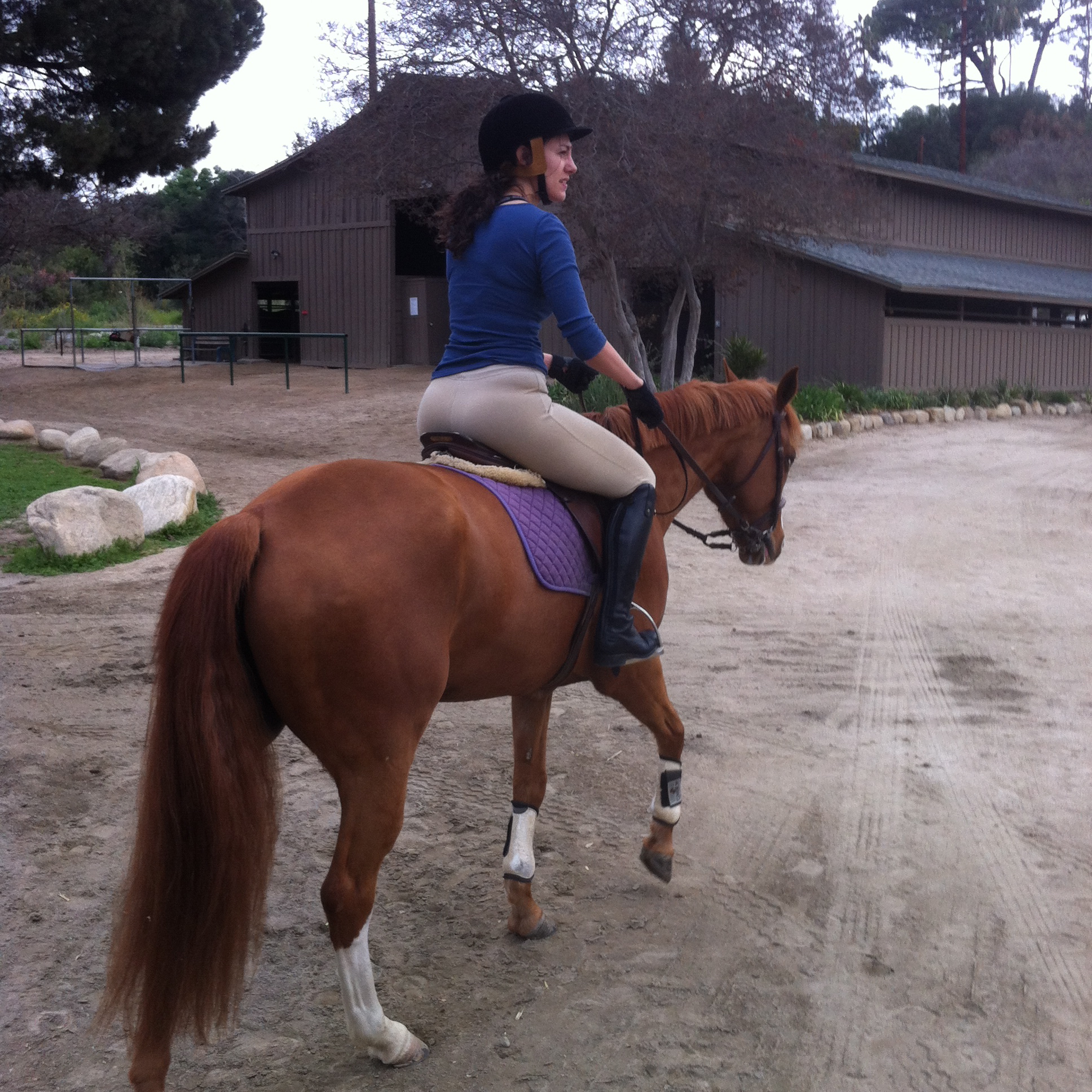
Headed for the big girl ring.

I was a little behind everyone else getting on, so I didn’t get to do a long warm-up before we dove into jumping. I could have used a little longer to get warm and stretch into my legs; I felt especially tight in the area behind my knee. The tops of my thighs have gotten a little bit more toned and flexible, so they feel less tight, but the area around the knee is still difficult.

The course we did was tough. It involved changing direction a couple times, which was difficult mainly because Bella is sticky on her flying lead changes (she gets them in front but sometimes not in back). There were also a couple of oddly-angled jumps that made the approaches interesting. The first couple times around, my reins were too long and I was being too passive; Bella is a young horse and needs a lot of riding. I really had to push her up and pull on the reins to take contact on her mouth for us to be connected enough to get the distances right. Pushing her up was hard for me today, I just felt like I had no energy in my legs. Pulling her back was difficult too; she is stronger than I expected given her size and had a tendency to pull me forward in the saddle. I needed to sit up and wait instead of anticipating the jumps as I did many times. Going over a jump awkwardly feels awful, but once I took that control things went more smoothly. At least, upon watching the videos my boyfriend took of me, it doesn’t seem to look as bad as it felt.

You can watch the video of the best course I did here. (I have about 300 times, studying all the ways I can make it better next time.)

Equestrian Fitness: Stamina

Everyone who rides has been treated many times to the ignorant refrain of “You’re not an athlete–the horse is doing all the work!” But the truth is that riding a horse takes an incredible amount of stamina. Simply holding onto the horse uses so much energy, and you’ve got to make it pretty on top of that. You’re controlling the movements of an animal that is like 15 times your weight, mostly with your legs. I know that after cantering around the ring a few times, I’m blowing just as hard as my horse. After a course, I’m always winded.

I build muscle rather quickly. I can develop flexibility when I put my mind to it. But stamina has always been something I’ve lacked. In high school, I ran track for one year but was only able to do sprints (and hurdles, which destroyed my legs with shin splints for many years). The idea of long distance running was hellish to me; I thought the cross-country team was a perverse cult of masochists.

I need to build up my stamina for riding, but also because having more stamina will make me able to work out better to increase the other two aspects of equestrian fitness, strength and flexibility. To that end, I’ve tried a couple of things at the gym:

Running: Since I have always pretty much hated running, this has been a long, slow build up for me. I started out running on the treadmill and simply trying to run a whole mile without stopping. Then I tried to run two. Then three. This necessitated understanding my limits and learning to pace myself; those miles were pretty slow, 11-12 minutes apiece. Three miles is just about the farthest I’ve ever run, mostly due to the time limitations of going to the gym after work. Next I started focusing on increasing my speed; I dropped back down to one mile, but each time tried to do it faster. Eventually I decreased my time from 11 or 12 minutes down to a little bit over 9 minutes per mile.

After a few months of doing pretty much the same thing–a quick mile as a warm-up, then moving onto weights–it started to get pretty stale. Exercising without variety is not only problematic because it’s mentally unchallenging, it also doesn’t push your body enough to keep building stamina.

The recommendations about what exercises are “best” or “most effective” change about as often as the recommendations on what we should and shouldn’t eat, and so tend to be something I avoid making myself crazy trying to follow. But the current story seems to be that interval training has a lot of benefits: increased calorie burn, increased efficiency of oxygen getting to the muscles, greater efficiency of lactic acid breakdown, and a steady increase in overall stamina. I’ve done intervals before and they’re pretty fun, so I’m giving them a go again. Possibly the biggest benefit for me is that intervals are mentally engaging. It’s like a game: every time I try to beat my previous best.

Here’s what I’ve been doing: I run about a half mile at a medium pace to warm myself up, with a few short bursts of going slightly faster than is comfortable. Then I do about 5 intervals wherein I sprint all out, followed by a rest period of walking. I started out doing 30-second sprints, then upped it to 45 seconds, then a full minute. The last time I did this, two days ago, I went to a 1:15, and next time I’ll try to do 1:30. Each day it gets easier. I was gasping for air after my first few attempts at 30 seconds, and now at that point I’m still in the “I’m fine” territory. Picture a meter, like the temperature gauge on a car. At 30 seconds I’m still in the blue. Around 50-55 seconds I’m starting to redline and want to stop so desperately. But the important part of intervals is you have a set time you have to get to. I used to go into exercises with the mentality of “I’ll do this as long as I can,” but it’s always easier to punk out that way and not push yourself as hard as possible. It’s easy to convince myself it’s time to stop at that 50-55 second mark when my lungs are screaming at me that I have no air left, but if the goal is to get to 1:15, I always find a way to hold on until then.

One way in which I go fairly easy on myself is that I don’t define an amount of time for the recovery. I just slow down and walk until I catch my breath. It would be more effective if I pushed myself to recover more quickly, and that’s something I plan on working up to. But for now, I’m focused on extending the length of my sprints.

After the third or fourth interval in a given day, it starts to get harder and harder. Intervals really tire me out quickly. So I’ve adopted a rule for them called “One After Done.” That means that after the interval that feels like it has demolished me and I can’t do anymore and I’m absolutely done, I have to do one more. That way I know I’m going to my furthest limit and building as much stamina as possible.

Cycling: I also go to a cycling class once or twice a week. It’s called “Les Mill’s RPM,” part of a series of Les Mills classes that they do at my gym, 24 Hour Fitness. It’s also known as “that psychotic spin class,” which is how I’ll probably refer to it from here on out. Let me begin my saying that group exercise is not my fave. I don’t like other people looking at me when I work out. I chafe at an instructor deciding my limits for me, and I flat out will not tolerate being yelled at. So I was reluctant to try this class. But my boyfriend convinced me to try it. His point was that sometimes you really do need someone to push you past your limits and that I might get something out of it. He was right. The instructors I’ve taken the class with do encourage everyone to go faster and harder, but they are not the screamy types.

The class isn’t all intervals, but incorporates a lot of interval training. As you ride the stationary bike, there’s a knob to adjust the resistance on the pedals. The instructor tells you when to put it up and down as you go through a series of sprints and climbs, sitting down and standing up in the stirrups. It’s pretty amazing for building up thigh and core strength but it is really, really hard. The hardest part for me is of course the cardiovascular stamina. Whereas I am (perhaps too) kind to myself on the treadmill with letting myself totally catch my breath in between sprints, this class does not give you much time to recover. The next song comes on right away and you’re back at it. Sometimes I drape my body over the handlebars, put my head down and close my eyes for a couple of seconds just to breathe and convince myself I’m not dying.

The “One and Done” rule doesn’t really apply to this class, mostly because at the time I feel done there are usually several more songs to go. I just try to finish the class and do all the things the instructor is doing–keeping it at her speed and resistance. It’s getting easier, especially now that I’m going twice a week. But it also sort of never gets easier because you can always put the resistance higher, and as you get stronger it’s kind of necessary to do so in order to keep the pedals from getting out of control. I’ve started going to this class the night before my riding less, replacing the yoga class I was going to previously. I find this is a better workout before riding. My original thinking was that a low-intensity stretch the night before would do me better on the horse, but actually just blasting my thighs and core makes me feel looser and warmer the next morning for riding. It also hopefully gives me more stamina so I can continue challenging myself in the ring.


Equestrian Fitness: Flexibility

I think there are three aspects to equestrian fitness. The first two are strength and stamina, and I think the third is one that is often left out: flexibility.

I’ve found this to be the most difficult thing about coming back to riding as an adult. When I started riding again about two years ago after my nearly decade-long hiatus, of course my muscles were not in shape. It was hard to grip with my legs; it was even more difficult to squeeze a slow horse to move on. It was very hard to hold my upper body still. But I had muscle memory helping me out there. So my muscles knew what to do and would instinctually do it even though they weren’t really strong enough. It’s a lot faster and easier to train muscles that already know what to do and simply need to get stronger to do it than it is to start from scratch and teach them what to do. It’s something my riding buddy and I talked about a lot, how we couldn’t fathom starting to ride at our age if we hadn’t had so much experience in our youth.

Training my muscles to get stronger wasn’t too difficult, and I noticed a difference there right away. Every time I’d go to the gym to run or to do the leg weight machines, I’d see results; I’d be able to run faster and longer, or I’d have to put the weight up on the machines. But I wasn’t seeing the same results when I rode. My legs were objectively stronger, yet not a great deal more effective at doing the things they were supposed to do on the horse.

The amount of time it took me to warm up seemed to be the issue. I’ve noticed as I’ve aged that in general it takes longer to warm up. This is even true on the pitching mound, where I used to be able to throw a few warm-ups and then step right into the first inning and now if I don’t get to a game early and go through a whole warm-up routine, I won’t hit my stride until the second or third. In my riding lessons, it was taking me most of the lesson to get warm—flatwork was agony and it was like I was just getting started when I took my first jump. I tried stretching at home before the lesson, doing a little light yoga and calisthenics to get the blood flowing, but by the time we drove out there and mounted up I would be cold and inflexible again.

Warming up before a big exertion is useful and necessary, but there’s a lot of controversy about whether stretching before exercise is helpful at all for performance and recovery. But it’s not just on the horse that I feel my flexibility has become limited; it’s all the time. The area between my lower back and my knees, including lumbar muscles, my hips, hamstrings, and IT band seem to be all jammed up all the time. I feel them tightening and pulling on each other when I walk or sit. So warming up isn’t the only issue, it’s my general flexibility.

All of this has led me to do some research into the anatomy of these areas. The thighs are particularly interesting. Most people are familiar with the quads and the hamstrings, but there is a whole group of muscles called the adductors on the interior of the thigh that work to keep your knee rotated correctly and your leg stable. Looking at a diagram of these muscles, I was able to pinpoint the one that seems to be the hardest for me to stretch when I’m riding: the gracilis muscle. It’s the most superficial of the muscles on the interior of your thigh; a long, thin muscle that goes from your pubic bone all the way down to your knee. It is involved in the flexion of both your hip and knee and it’s the muscle that prevents all of us from being able to do the splits. When you’re riding, it’s the muscle that is directly against the saddle, the first line in holding yourself onto the horse and keeping your knee closed and bent at the correct angle.

gracilis
The gracilis muscle extends all the way to the knee.
adductors
Adductor muscles in the thigh.


Merely strengthening this muscle is not enough. I’ve spent plenty of time over the last several months using the adductor machine at the gym (and its counterpart, the abductor) to strengthen those muscles. But when they are tight, they aren’t particularly useful to me. I can’t access the strength I need from them–to let my leg really lengthen and wrap around the horse–if there’s no flexibility there.

So now I’m trying to seek out exercises that will specifically target flexibility in that area. My first thought is yoga. I’ve been going to a class once a week for the last few weeks but haven’t gotten much out of it physically because it was very meditation-focused; I’ve now found a different class that is more anatomy-focused and it seems to be a better fit. I’ve only gone to that one once but will continue to go weekly to build flexibility throughout my body. I will probably also do some practice at home using poses that are focused on this region. I found this informative blog post with a list of poses helpful for healing, strengthening, and stretching the adductor muscles.


Equestrian Fitness: Upper Body

It’s obvious that in order to be a strong rider, you need to strengthen your core and your legs. But what about upper body? It seems like this is an area that riders–and women generally–tend to neglect in their fitness routine.

I’ve found, mostly by accident, that a strong upper body improves my riding in so many ways. I would go to the gym and do a bunch of lower body exercises: running, squats, cycling, and all the thigh-oriented weight machines. Those have all done great things for me and I’ll touch on them in another post. But I realized that if I was going to be all-over fit, I had to target the rest of my body too. My original goal was to lose some weight and to look a bit more toned. The rationale was that muscle burns more calories so putting more muscle everywhere on my body that I could would speed up the burn.

I think a lot of women avoid the upper body weights area at the gym for two reasons: 1) not wanting to look like a dude and 2) dudes. To address the first, I’ll say this: you won’t. Unless you’re taking steroids (which, just don’t) then your feminine form is safe; lifting even heavy weights is not going to make your arms muscled like a man’s. As for the second, it’s true that the free weights area is an especially testosteroney zone in the gym. For some reason the guys are all really hyped up over there about each other and there’s a whole lot of posturing going on that only gets worse when a girl is thrown into the mix. At first it really put me off, but I’ve learned to just ignore it and laugh about it in my head. I’ve found that the weights machines are a little less fraught and seem to have a more reasonable male-to-female demographic if that makes you more comfortable. Plus, if you’re just starting out, one benefit of the machines as opposed to free weights is that your movements are constrained and guided by the machine and you might be less likely to hurt yourself overextending your range of motion.

It might be tempting to go for the more simple-looking machines that target the familiar small muscle groups like the biceps and the triceps, but we’re going for more than just toned arms here. The goal here is to strengthen the chest and the back for better equitation posture, better airflow, and more control of your horse. Also, most of the machines that target these bigger muscle groups also work the smaller secondary ones as well, so you’ll still end up with nicely toned arms.

Historically, I have had pretty much zero upper body strength. On top of that, the tone I do have is completely lopsided; since it comes mostly from pitching softball for nearly a decade, I have this disproportionate right bicep that looks really big compared to the left one, but which really provides no strength since none of the other supporting muscles are strong.  I can do zero unassisted pull-ups at this time. I can do a decent amount of push-ups (20-30) if I am balancing on my knees, but can barely do any (maybe 3-5 on a good day) if I’m in full plank/push-up position. My back is a particular weak spot, having hunched over a desk forever. So there’s a lot of work that can be done.

My approach has just been to browse through the machines and keep trying new ones that look interesting. There’s a little diagram on each one that shows which muscles it targets and a few instructions on setting it up to your size. I make a guess about how much weight I think I can lift (sometimes based on checking out whoever used it before me) and make adjustments if necessary. I lift the heaviest amount of weight I can handle for 6-8 reps and do three sets of that. I used to do the opposite, putting the weight relatively low and doing a lot of reps because I thought I was going for tone and that’s the way most women go about it. But I’m going for strength and since I’ve started doing it this way I’ve gotten much better results.

Variety is a good thing here; before I had just a couple of machines that I was comfortable with and stuck to those but it’s important to branch out. I want my whole upper body to be shored up with muscle so that when I sit up tall in the saddle, it’s like a framework that already exists and I don’t spend mental and physical energy holding myself up all the time. I noticed a difference right away in my lessons. My posture was much more upright, my shoulder blades much more supple and able to support and open up my chest. My mid-back was much more still; I didn’t get pulled forward as easily by my mount tugging on the reins or being heavy on the forehand and I didn’t rock so much in the saddle at the canter.

So I keep trying as many of the different machines as possible to get an all-around strength. It’s important for creating that balance and harmony among the whole muscular system; you don’t want one thing to be really strong and another part of be really weak because it will pull you out of whack compensating for that. A good tip my boyfriend told me was that if you work a muscle by pulling, then you should also do the opposite motion and work it by pushing. (Think of the thigh adductor and abductor machines, aka “the inny and the outy” in my nonsensetalk language; the one where you use your inner thighs to push the pads between your knees together and the other one where you use your outer thighs to push the pads between your knees apart.)

That being said, here are a few of my favorite upper body machines specifically for building strength for riding:

1) Chest Press: This is the one where you sit and use the handles at chest height to push out until your arms are extended; it’s basically like a seated push-up. This has made the biggest difference in my posture of any exercise I’ve done. Opening and lifting the chest is one of the most important visual components of having perfect-looking equitation but there are a lot of practical reasons for that. Firstly, you can breathe a lot easier, giving you much more stamina for keeping that slowpoke horse from breaking or having enough air to get you through that long course. Second, it gives you better balance in the saddle, reinforcing that line we’re supposed to keep from shoulder to knee to ankle. If your chest is caved in and your back is rounded that throws the weight of your head and neck forward and down and limits the effectiveness of your seat. Thirdly, what follows naturally from having better balance in the saddle is your horse having better balance and you having more control. When you sit up with your chest open, your head and your hands come up and that brings your horse’s motion up as well. With an open chest you have so much more strength for sitting up to give your horse half halts to gain a little control, to enact smooth downward transitions and stop the horse completely, or even to stay on if he decides to buck. Finally, a strong chest will help you keep yourself lifted in jumping position so you don’t collapse on your horse’s neck on the landing. An added bonus of the chest press is that it works the triceps as well which will help you to pull back from the elbow on those reins. Another machine that also works the chest and triceps in a slightly different area is the Chest Fly, I like that one a lot, too.

2) Mid-row: This is the balancing movement to the chest press, working the middle of your back just below the shoulder blades. This will help your posture in all the ways described above, working in concert with your chest muscles. Sometimes I do the weight machine with this motion and sometimes I switch it up and do the rowing machine that simulates a row boat, where you put your feet in the stirrups and push with your legs while pulling on the row bar. That one is good because it also works your legs and adds a cardio component, but the resistance is lower than you can get by using the weight machine.

3) Lat pulldown: This works more of the upper shoulder blades and also the muscles down your spine to your spinal erectors. It will help create that framework I talked about earlier of holding up your entire upper body. It also works your biceps, which is a good counterpart to the tricep strengthening of the chest machines.

Finally, since this was an area where I’ve felt especially weak, I’m incorporating a daily challenge at home to really push myself. I’m doing this 30 Day Plank Challenge. To really get results quickly, I’m not only doing the one shown in the picture where you rest on your forearms; each day I’m also doing a full plank with arms extended and a full side plank on each arm.  This is great because it not only boosts your upper body strength, but works your entire core.

If you’re looking to increase your strength as a rider, don’t neglect your upper body! In equitation there are so many things to keep track of in your own position in addition to controlling the unpredictable 2,000 pounds beneath you. The only way I’ve found over the years to keep it all together is for some things to become second nature and drop from my immediate consciousness to free up space for what’s going on in the moment. I call this “dropping below the line.” Theoretically, it would be ideal for all considerations of position to be below that line and for perfect equitation to be instinctual. For years now, my upper body has been “above the line,” a constant focus and something my trainer often has to remind me of. Strengthening these previously-neglected muscles and creating a framework for my upper body has allowed me to drop that part of my position below the line of consciousness and frees me up to become a better, more present rider.


Fitness

My lesson yesterday left me pretty sore so this morning instead of going to the gym, I’m in recovery at home. When I’m tight and sore, the natural response is to not want to move at all. But I’ve learned that “recovery” is not simply about doing nothing–rest is important, but so is stretching and moving in a way that will help those muscles heal.

This morning while doing my own version of recovery–some light yoga and using these amazing things to work out the really painful kinks–I was thinking about my own fitness regimen. I’ve read many articles and blogs talking about the best exercises to get you in shape for horseback riding. All-over muscle tone, but particularly core and leg strength, is usually the focus. Clearly, the best way to develop riding strength is to ride often. But I’m finding that there are certain exercises that develop enough tone to make my lessons much more productive; having that “head start” of some tone in the muscle helps those parts of my body warm up more quickly and operate with more suppleness in the lesson, which in turn probably leads to building the muscle more quickly.

I thought I’d share what I’m finding here–basically through trial and error–in case it’s helpful for anyone else. The fitness regimen I’m trying to establish is not only for riding, although getting back into the best shape I can for that is one of my main goals. I’m also realizing how important fitness is as a part of life. I’m at the age where during the next several years, muscle tone will start sharply declining and I want to head that off at the pass as much as possible so I can continue leading an active life. Putting the work in now is setting me up to include fitness as a major part of my lifestyle for the rest of my life, and I need that.

As a child I was incredibly active. I was naturally athletic, energetic, and thin. As I’ve aged, my metabolism has changed and I’ve accepted that as a natural part of aging. I’ve continue to consider myself “active” since compared to most people, I was. I walked a lot. I played softball twice a week for half the year. I rode horses every other week. I tried to make it to the gym once or twice a week for a run on a treadmill and some weight-lifting. I occasionally rode my bike around the track in the park a few times. As I type that now, it sounds like a lot. But it’s not. At no point in any of those activities did I really consistently push myself.

In the last three to four years, I put on what for me was a lot of weight. Part of this can be attributed to turning 30. Part of it can be attributed to sitting in a dim hole of a cubicle without seeing a window for the better part of a year and my Seasonal Affective Disorder getting out of control. Much of it can be attributed to a great deal of stress from a variety of sources. I looked ok. I was still “thin” by most people’s standards, and my friends mostly told me to shut up because I was fine. But I didn’t feel fine. I felt like I wasn’t myself, like the body I was inhabiting wasn’t even mine. And a huge part of what felt integral to my personality–my ability to be active–was slipping away. Fatigue, muscle aches and worsening headaches became the norm rather than the exception. I started to become depressed at the thought that I’d never be able to feel energetic and healthy again.

Since moving out to LA about a month ago, I’ve gone to the gym almost every day. It’s a lot more accessible to do so, since I just hop in the car and drive for about 5 minutes to get there, instead of negotiating bringing all my gym clothes to work and convincing myself to get off the subway a few stops before home to walk several blocks in the cold to work out. The gym here also costs me about $40 a month less than it did in NY while at the same time being much nicer and having more equipment, classes, and amenities.

After this month of working out, I’m starting to feel a little bit better. But really, I’m just scratching the surface. It’s made me realize how much damage has actually been done by the complacency of my sedentary lifestyle. I realize that because fitness came so naturally and easily to me as a child and a teenager, I’ve expected it to be that easy as an adult. And it’s not. It’s hard. If I want the level of fitness and athleticism that I had before, I have to really, really push myself to get it.

I’ve also realized how important that is to me. I think there’s a kind of shitty peer pressure pervasive in our culture to not make fitness a huge priority because if you do, it makes the people who don’t feel bad about themselves. There’s the stereotype of an image-obsessed “gym rat” chick who is trying to get impossibly skinny, or the musclebound meathead guy who can’t put his arms down. The fitness world certainly does have its own particular breed of psychosis (as does every sort of niche); I’ve seen some of that here and I don’t even live in the really crazy part of town. But as with everything, balance is key. Pushing your body to freakish proportions is unhealthy and so is neglecting it entirely.

So, going forward in addition to my weekly lesson post, I’m going to also write about my adventures in getting in shape. I’ll mainly focus on what works and doesn’t work for me as a rider, since that’s the topic of this blog, but obviously there will be overlap on what just works generally. I want to become the best rider that I can be–I’m curious as to how good that really is when my body is also the best it can be.

Get Out of The Way

Lately, our trainer has been trying to hold horses for us to ride in our lessons. When we get to the barn at 1 pm on a Saturday, it’s pretty hectic and our usual mounts have often already had their quota of rides for the day, leaving us with few options. After a difficult lesson a few weeks ago before Thanksgiving, this week she tried to get a horse for me that I love and feel comfortable on–either Jasper or Summer–to make sure I’d have a better and more confidence-boosting ride this time.

Jasper was already being ridden and Summer would be used in a horse show at the barn the next day, so that left me with only the more challenging options–basically, the two ex-racehorse mares, Sparkling Gal and Misfit, and another mare named Star that we’d never seen before. Riding Buddy, being the more adventurous of us lately, chose to try out Star, who was a tall, lovely chestnut with a big jump. Deciding between the more mental/emotional difficulty of keeping skittish Sparkle calm in a crowded ring, or the more physical challenge of slowing the calmer but still strong Misfit in the same environment, I chose the latter. I was slightly rattled, having expected an easier mount. Sitting there, hemming and hawing over what seemed like all bad options, I was annoyed at myself. There was a time when I’d ride anything in the barn. I don’t like to think of myself as a tentative rider.

When we started the lesson, I remembered how much I liked Misfit the one time I’ve ridden her previously. She’s quite sane for a Thoroughbred mare, sensible and comfortable to ride. She wasn’t fazed by the crowded ring and didn’t seem interested in charging around.

Misfit’s biggest challenge is getting the correct lead on her right lead canter. In contrast to the last time I rode her, she and I both seem to have strengthened our muscles a great deal. The last time I rode her, back in July, my body was totally different. I was ten pounds heavier then, had no muscle tone, and as a result my muscles were very tight and cramped. That made it difficult for me to sit up and marshal her through the tight circle we canter on to keep her from switching to her more-comfortable left lead. But this time I had so much more strength and control. Last time felt like a sloppy mess; this time I felt like a rider, like I was working hard to get something done but I actually had proper form doing it as well. As for Misfit, I could definitely feel the difference in her as well. They have been working with her a lot more recently at the barn to strengthen her right lead and the results are apparent. Her balance is improved, her bend is more flexible. She didn’t break once in the canter and didn’t once get flustered and switch to her other lead. I was very proud of us both.

After the difficult right lead, it’s a reward to get to canter her on her left. Her canter is smooth and comfortable and propulsive without being manic.

As we prepared to jump, I found myself with those little prickles of doubt and worry creeping up on me. I know that Misfit can get a little fast on the approach and take a big jump and that made me a bit nervous. The important part of that sentence is that I said I felt nervous, and not anxious. I realized the distinction on the drive home from our lesson. When I say that I felt nervous this time around, the difference from the anxiety I’ve felt before was that it was more easily dispelled. The nervousness was a state I was in relating to a specific thing; I was nervous to take the jump because sometimes Misfit gets fast. The anxiety I’ve felt before has been, I think, triggered by situations such as this that might normally cause nervousness, but the feeling has grown out of proportion and has expanded to encompass larger, more global fears about myself and about life and because of that it has taken over and shut me down. Nervousness doesn’t shut me down. I just say to myself, “What’s the worst that will happen? She’ll get fast. You’ll slow her down.”

Nervousness is in my mind; it is a thought that can be dealt with rationally. Anxiety is everywhere, a fear that I feel throughout my entire body. Horses are very sensitive to this; they can feel agitation in the rider and that agitates them in turn. Because I didn’t have that bodily response, I didn’t infect Misfit with it. As a result, she didn’t even get fast over the jumps. She took them beautifully. And because she was taking them beautifully, so did I. My trainer said my equitation–something I’ve felt I’ve always struggled with because I’m generally more focused on getting the job done than looking pretty while I do it–was perfect. She keeps telling me that when I don’t put up these mental blocks, that when I get out of my own way, I’m a great rider. It’s been hard for me to feel that for a long time, but today I felt it.


Life Lessons

It has been weeks since we’ve been riding, since my riding buddy and I both had plans for the last several weekends. In the interim, however, I’ve been working on getting fit in earnest.

There are a some lessons in life that, when realized, are blatant, obvious, and so clear that I think they become underestimated, lost in plain sight. These are things that we must learn over and over and over again and then kick ourselves for all the time spent living poorly without their practice. One such lesson, which I will have to get tattooed on my forehead it is so vital to living, is that I have to be active. Ideally, I’d be engaged in a sport or a hobby, or–even better–a job that keeps me physically active. Softball and horseback riding are two such pursuits, but they are not enough. In the absence of a nonstop fun-filled sporty lifestyle, I need to make exercise a priority. And perhaps the lesson I’ve learned lately is that it needs to be one of the main priorities. It can’t be something that is done half-heartedly, as a dispirited attempt to mitigate the bodily strain caused by the sedentary life of an office worker. It needs to be something I that I really challenge myself with.

The first week or so of getting back to the gym is always hellish. It is a chore and everything feels awful. But there’s a hump to be gotten over and once I have, I actually start to feel awful if I don’t work out. Once I start really feeling the results–as I did this week during my riding lesson–I get even more motivation to keep going.

But then something always happens to interrupt the momentum. Usually for me, it’s the shortening of the days and the dropping of the temperature. Despite the clear evidence that exercising is the best thing to mitigate the worst of my Seasonal Affective Disorder symptoms, those very symptoms are what usually keep me from exercising. Fatigue, depression, a physical sensation of heaviness in the limbs all eventually combine to convince me that I’m not capable of doing much of anything, let alone going to the gym.

I’m hoping that this time around, I can finally make exercising a part of my lifestyle, instead of just a habit that I form briefly between periods of inactivity. I feel like I am working out smarter than ever before, using weights to build up all the muscle I’ve lost over the years and then doing a bunch of cardio to burn off the fat. And there is a focus this time around that I’ve never really had before. The gym, with its TVs on every machine, is set up to distract people from what they are doing. The message is, “This is horrible, but you have to do it…so you can watch TV at the same time to make it more palatable.” I can’t watch the TVs. In addition to my seeming allergy to TV these days, it takes away my focus from what I am there for–to make myself stronger. If the mind wanders, I can’t think about getting the most out of what I’m doing. It’s easy to fall into a rut of just absentmindedly lifting the same amount of weight or running the same distance and speed. It takes a lot of mental energy in addition to physical energy to keep adding weight, to keep pressing that button to raise the speed on the treadmill. And that’s what keeps me engaged. Playing games with myself, negotiating with myself about my limits–“Can you do another whole minute at this speed?”

All of this paid off this week in my riding lesson. The muscle tightness that has been preventing me from being effective on the horse is not there anymore. Instead of taking almost the entire lesson to warm up, I was warm after a few minutes of flatwork, as I should be. I was able to get my heels down, able to support my horse with my leg, and able to hold my upper body steady. I realized as I was riding that I wasn’t having to try to force it. There’s enough strength in my body again to give it suppleness. And that suppleness allows me to do something that makes me even more effective than simply muscling my way through it–it allows me to relax.

I’ve been reading The Art of Seeing by Aldous Huxley and I thought about it while cantering on Jasper this week. Huxley wrote the book in 1939 after a time of near total blindness and then a years-long period of severely impaired vision, after which he was introduced to the methods of W. H. Bates. Bates wrote about a re-education in the way we approach seeing that for Huxley, as well as many others, completely transformed and improved vision malfunction. According to Huxley, one of the main problems in any art–whether it be seeing, learning an instrument, or horseback riding–is the amount of tension and anxiety brought by the performer. He speaks of something called “dynamic relaxation,” the counterpart of “passive relaxation,” or a state of complete repose and rest. Dynamic relaxation is “that state of the body and mind which is associated with normal and natural functioning.”

When my muscles are weak and I’m straining to just keep up the most basic equitation, it makes me get in my own way. Worrying about why I can’t do what I need to do and feeling the ego loss associated with not performing to the level I know how to perform at make the tension and anxiety worse. Huxley says,

“Malfunctioning and strain tend to appear whenever the conscious ‘I’ interferes with instinctively acquired habits of proper use, either by trying too hard to do well, or be feeling unduly anxious about possible mistakes. In the building up of any psycho-physical skill the conscious ‘I’ must give orders, but not too many orders–must supervise the forming of habits of proper functioning, but without fuss and in a modest, self-denying way.”

It’s all a balancing act. Being focused and invested enough to perform well, but not so much that I become anxious about not. Of course, that’s the other lesson I keep having to learn: balance. It seems like every day, in every single part of my life, it’s what I keep coming back to: find balance. Security and freedom. Pushing myself to improve without browbeating myself with perfectionism. Including my emotions in my decisions without letting them overrun my thoughts. Practicality and passion.

I wrote earlier about needing an outlet in which to throw myself wholeheartedly, about needing change and finding work that fulfills me. About wanting to feel like a strong, engaged, alive person who is able to do amazing things. Most of my focus when trying to enact that change has been on external circumstances; trying to get myself to a situation in which it will be easier to do what I want to do. But recently, I feel like I’ve been doing a ton of work internally as well; throwing myself into finding the balance in all these areas to be the person I want to be, so that I can do the things I want to do. It’s a daily struggle, but just like the working out, it feels like it’s paying off. It feels like maybe soon I’ll get over the hump and then finding balance will not be something I have to force myself to do with distractions, but something I can delight in, do naturally with strength, flexibility, suppleness and without tension or anxiety.

Insecure

One of the most frustrating feelings in the world is knowing what you need to do, and being physically unable to do it.

I’ve been back to riding for just about two years now. I rode for how many years when I was young–thirteen? The most basic piece of information–the first thing–you can tell someone about riding position is to put their heels down. And yet, for the last two times I rode, I just couldn’t do it.

I’ve been doing a standing desk at work for a while now. In many ways, it’s much better for me than sitting–my upper back hurts less, I have less mental fatigue, I walk around more. I’d probably be even more out of shape if I weren’t doing it. But I think it’s making my lower back really tight. And from my lower back, a straight line down through my hips, hamstrings, and calves. No amount of stretching seems to relieve this tightness throughout my lower body. Exercise would help, I think, but with that unfortunately we go right back to the first sentiment in this post: knowing it would help, being unable to do it.  For the last couple of months, that has been the case. Worn down, I haven’t been as active as I like to, need to, be. I’m picking it up again now, having exercised every day for the last six days, and I’m starting to feel better.

Today, however, was a rest day. I intended to go to the gym but thought the better of it after yesterday’s lesson. The reason I’m bitching about my heels, seemingly such a little thing, is because without your heels down, other position problems arise: like not keeping your weight down in the saddle, like having a difficult time sitting up and back; all things that make you insecure in the saddle when the former racehorse you are jumping gallops away from the fence and stumbles on the turn. And when you’re insecure in the saddle under those circumstances, you go flying over that former racehorse’s lovely, sleekly muscular shoulder, and hit the hard-packed dirt of the indoor arena with plenty of force. And maybe your helmet, not of the most secure fit itself, despite protecting your brain from bashing itself on the ground with a good bounce, still manages to bang down onto the bridge of your nose and hurt like hell. I thought for a bit yesterday that the nose might actually be broken, but the lack of blood and minimal swelling have convinced me otherwise.  But it’s not pleasant. My glasses resting on it and my boyfriend leaning in for a kiss are both making me wince a little today.

The fall wasn’t Sparkling Gal’s fault. She just tripped. And, according to my trainer, she did so after “the most beautiful jump” she’s ever seen me take. We were in the indoor, having gone out intending to do a “club ride”, wherein you take a horse out without an instructor, thinking that ours was going to be out of town and we could just work on our own. But when we were surprised to find she actually was there that day, we hurried onto our mares (me on Sparkle, and my riding buddy on her new favorite, Misfit) for a regular lesson.

I had already been slightly frustrated on the flat, especially at the canter, at my inability to get loose enough to really stretch down and sit deep in the saddle. Sparkle has a choppy canter, and makes me think that I’m looking quite sloppy on her, despite reassurances from the riding buddy and instructor both that it’s not as bad as I think it is.  Knowing that she is a joy to jump, I looked forward to that part of the lesson, even though being in the indoor due to the high temperatures outside limited us from doing anything resembling a course. There were two jumps set up: a small cross-rail and, on the opposite side of the ring, the vertical after which I took my tumble. Since the vertical was big enough to require us to go at it at the canter and both of our mounts can get quite strong, our instructor only wanted us to do it by itself once before connecting it with the cross-rail, intending us to trot the smaller jump and then come around to the vertical at the canter.

I got up pretty quickly after the fall. It doesn’t take long to take stock and know there isn’t anything terribly injured, and I’m always anxious to put everyone else at ease that I’m fine. After a brief inspection of my nose, I knew I was well enough to get back on even if it was broken, and was ready to do so after a quick, steadying drink of water. My instructor was not going to push me–she said it was entirely up to me how much or how little I wanted to do. My first instinct was that I would just take the smaller jump at a trot and be satisfied with that. But I really knew that I needed to take that same vertical again in order to be pleased. So I said, “I’m going to take the cross-rail, and then we’ll see about the vertical.”

The first time, the cross-rail went fine; Sparking Gal went in very quiet and was manageable on the landing. But with the other horses in the ring, our approach to the vertical wasn’t great and I circled, deciding to forego it. At that point, again, I said, “Ok, I think that’s enough.”

But I watched my riding buddy go again through the jumps, taking them beautifully, and I felt the restlessness stirring inside me. “Ok,” I said. “I’m going to try it again. The vertical is still a ‘we’ll see'”.

This time, I did it. The sweet mare was good to me over the cross-rail and I sat up as best I could with my stupid heels and settled her back through the canter approach to the vertical. She ate up a little bit of ground on the approach, but we took off with good timing and had a nice jump on the vertical. My right foot jiggled a little bit in the stirrup, I felt my balance loosen through the turn as she was a little skittish going through the spot where she had stumbled, but I pulled myself together and held on, very pleased with myself for having done it. I knew that if I hadn’t, it would be an issue the next time around. This way, I won’t be–at least mentally–insecure the next time I jump.

Impossible

I haven’t been writing lately for a number of reasons, but mostly because I just haven’t felt like it. I’ve had a few lessons that were generally positive. I’ve even started volunteering at GallopNYC, a therapeutic riding program for children and adults with disabilities. I go once a week and help out as a side-walker, helping the rider be secure on the horse while they go through the exercises and activities that the instructor has planned. It’s rewarding work, and I get to be outside and around horses another hour a week.

But most of my time lately has been spent trying to figure out what the hell to do with my life. I don’t want to do this anymore, and I need a plan to make a change. My boyfriend and I talk non-stop about what work we could do to fulfill us, where we could live that we’d feel connected and comfortable, and how, at our age, educational level, economic situation, and extent of career experience, we could possibly ever get to a place where we’d be even just not miserable, let alone truly satisfied.

This came up most recently after my lesson yesterday. Our old trainer, Hannah, has moved on since graduating, going back upstate to start her career in a less expensive place, so we now ride with Jess. We rode with her once when Hannah was out and clicked well, and I think it will continue to be a good match. I rode Jasper, whom I was surprised to find out that Jess doesn’t think much of–when I suggested him as someone I could ride, she said she thought he was kind of a dick. Apparently most of the trainers don’t trust him all that much, as he has gotten a little cranky in the indoor of late. I’m not surprised, though. Even though it is finally spring here, we’ve still been stuck in the indoor due to some heavy rains that have soaked the ground on the ring outside. I’m cranky about that, too. Despite a bit of sassiness the last time we rode, where Jasper threw a few bucks as we were cantering toward the jumps, I’ve never had a problem with him. That was true this week too, and Jess chalked it up to Jasper and I just “vibing” well with each other. I think he and I are just awkward in similar ways, and it works.

But despite him going well for me and having a generally good lesson, I was frustrated. I haven’t been as active as I’d like to be, lately falling into the spiral of “I haven’t exercised so I’m too drained to start exercising” that usually isn’t a problem for me this time of year. But softball has been irregular due to scheduling weirdness from the fields being renovated, I haven’t made it to the gym because I’m demolished after work, and I only ride twice a month at best. I’m a bit overweight, my muscles are weak, my stamina is reduced. I’m just not where I want to be, physically or mentally. I want to be an athlete: strong, fit, and pushing myself to do amazing things with my body. And as it stands, I am just a sort of thin person who is rapidly deteriorating at a rate that seems wrong for my age. I feel old. My joints hurt. My muscles are so tight that no amount of daily stretching seems to mitigate it; I fantasize about being put on the rack just to feel some space opened up inside my knotted-up body. This is the worst part for riding. I get on the horse and I know what I am supposed to do. I know to keep my legs back and my heels down, but I can’t physically do it because of how tight my inner thigh muscles are, and no amount of stretching beforehand seems to help. I know I need to keep my upper body still at the canter and between jumps, but my abs are a gelatinous mess. And I know, if I could ride a horse more than twice a month, I would be able to reverse this. I would get fit, my muscles strengthening and becoming flexible again. And because of my circumstances, because of how difficult and expensive it is to ride here, I despair of this ever happening.

I walked around, cooling Jasper down, and I thought about how I would like my life to be. I thought about my dream of becoming a horse trainer. I thought that I’m nearly thirty-three, totally out of shape, and with little to no experience training horses. Sure, I’ve been around them my whole life. Sure, I’ve ridden for nearly fifteen years in total (counting the time before and after my decade-long hiatus). But do I really have anything to show for it? No. I have no accomplishments, no awards, no job experience, no name. I have my abilities, I have my knowledge, but I can’t even show that properly since I’m so damn out of shape. And I think all these things, and I think I’m kidding myself that I could ever make a change, that I could leave this destructive, meaningless office work behind and work with horses.

Chatting at the end of the lesson, Jess mentioned a friend of hers who had just done a month-long internship in New Mexico gentling mustangs. I became excited to find out information about it, since that’s pretty much my dream. I came home and looked it up. For $1,500, which includes room and board for a whole month, I could go out there and learn how to do exactly what I want to do: learn how to train wild horses. They have a certification program that teaches interns how to privatize excess government horses and get them up for adoption (the process that I first learned about and became fascinated with over a year ago when I saw the documentary “Wild Horse, Wild Ride”).

This sounds amazing to me. I get so excited at the thought of going to do this, and I want to fill out the application right away. But then reality must be considered. How can I go to New Mexico for a month? I only have two weeks of vacation. In order to go, I’d have to quit my job. And then what? I go do this for a month, and then after the month is up I have no income, and no place to live. And this drives me wild. I can’t take one month out of my life, away from my job, to explore something that I think could be my life’s work, but which I don’t know until I try whether I have what it takes.  The only way to make a change is to entirely give up income, insurance, security, and stability.

It’s depressing. So many things seem impossible right now.


Thinking vs Doing

One of the symptoms of being cooped up in the indoor is that I have a lot more time to think about my jumping. Doing courses outside, I get into a rhythm with the jumps. I have space to feel the movement of my horse before, between, and after the fences and because of that my body is more attuned to what it needs to do; I can rely on instinct to feel the spots. In the indoor, everything is so stop-and-go. There’s a lot more downtime between fences because we are usually only doing a single jump or a line. It requires a lot of planning, like deciding whether I prefer to negotiate a clusterfuck of ponies on the approach or on the landing. On the approach it can make me so disorganized, often putting us off-center on the first jump because the turn has to be cut short to dodge all the other horses. That makes the whole line out of whack. I find that dealing with them on my landing is preferable, although only the lesser of two evils. It means that the whole way down the line I’m thinking about where I’m going to take the barreling 1,500 lbs underneath me so that it doesn’t crash into or run over anyone.

The remedy for this, I’ve found, is to take a lot of time to get set up. To circle, to plan, to wait. And all that time, I’m thinking about what I’m going to do. How my left leg is going to push my horse over to the center of the jump. How I’m going to hold him to the base, wait to find the closer spot. These are important things to think about. But thinking about them too much in previous weeks has, I think, gotten in the way of me doing them. In today’s lesson I focused a lot more on my bodywork on the flat and because of that was able to get back to more instinctual jumping.

I rode Jasper, who I believe is my favorite horse in the barn. He’s not the best mover or the best jumper. He doesn’t have the finesse of Max or the verve of Summer. But something just between us just gels and I tend to have my best jumping lessons on him. He was fresh when I got on him, making the flatwork energetic and fun. I worked a lot on lengthening and shortening his stride, making a game of weaving in and out of the other horses to keep our forward momentum. I also tried out the technique I used last week with Max to get him off the forehand. It was not as drastic a result with Jasper, but I certainly felt his head come up and his weight shift backward. With this balance, I was able to bend him a lot better than usual as well. As Hannah described it, he “turns like a motorcycle”, just chopping corners left and right. But today he was really responsive to my leg and more flexible than usual.

The main thing I wanted to focus on today was quieting my upper body–particularly on my transitions and over the jumps. Two things helped me do that. The first is a concept that I just recently re-read in Centered Riding, where Swift describes growing your upper body out of the saddle like a tree. The image in the book shows that below the waist are the roots, while above are the trunk (your spine) and branches (your arms, your jaw, everything that hangs). She suggests trying to stretch yourself up in the saddle to illustrate that “growing” is different.  When you stretch yourself up, your seat loses contact with the saddle. When “growing”, your body extends from your center upward as your legs reach down and around your horse. You have much more stable, and much less rigid, contact with the saddle and your horse. I’ve been practicing this growing with my upper body all week as I stand at my desk at work and as I walk around. I think what has contributed to being able to do that more easily is the second thing, which is that I’ve been swimming regularly. I finally have gotten on track with my workout schedule and have been swimming a few times now. I can already feel the difference it is making in my upper body, particularly in my chest and upper back. These are historically weak areas for me and have always been a problem spot in my riding position. But with this increased strength in my chest, the upper back is able to relax open, the shoulder blades moving down my back instead of my shoulders being forced open by my upper arms. The chest itself is more open as well. The area around my sternum pushes forward and upward, allowing room for my spine to extend naturally and my neck to lengthen, lifting my head.  With everything open like that, there’s so much more space for my muscles to do what they need to do. Instead of scrunching down and rounding my lower back to firm my upper, it feels like my muscles are free to stretch out and support the framework of my bones. There is simultaneously much more stillness and much less tension in my whole upper body.

So these things helped a great deal, and I was able to do what I set out to do. With my transitions, I took some extra time to set my horse up and with my tall and quiet upper body, had so much of an easier time using my legs to push Jasper into the canter. He picked it up smoothly and then once we were there, I didn’t have to take several strides to pull myself together as I usually would do when rocking my upper body to generate momentum; we were already collected.  And then when we were jumping, focusing on keeping my upper body still took my mind away from over-thinking my fences. I was much less hesitant than I have been in previous weeks. Jasper can always use some encouragement, even on an up day. We trotted into the cross-rail and cantered out over a low vertical. I know he can tend to hold back and go for the closer spot most of the time, but I wasn’t into “knowing” today. More connected than I have been in weeks, I could feel his rhythm, and without thought I closed my leg and went for it. He was right there with me and every time, we took off from a smooth, even, slightly big spot. And it felt great. The line felt like the exciting place it is, a place containing our inexorable and united movement toward the jump.