The Old Stomping Grounds

While researching dream jobs recently, I came across Nancy D. Brown. She’s a travel writer who decided to combine her love of travel with her passion for horses and now runs a website, Writing Horseback, that gives tips and reviews for creating the ideal horseback vacation.

Ms. Brown invited me to write a guest post on where to ride in Brooklyn. I gladly accepted and mentally returned to my old stomping grounds to review the barns where I used to ride. You can read the post here: Horseback Riding in Brooklyn, NY

Finding (What’s Good for You)

After about a month of looking, I’ve finally found a new place to ride.

There are plenty of stables in the greater Houston area. Some of them only cater to boarders and don’t give lessons to people without their own horses. Some of them give lessons, but don’t jump their school horses. Some of them focus only on dressage. One seemed promising on recommendation from another trainer, but when I checked out their website it said they were closing up operations and moving to South Carolina.

So I haven’t been on a horse in over a month.

I went out to Rainbow Hill Farm on Tuesday morning for a lesson. I’d already taken an informal tour and met the owner, Karen, who I felt immediately comfortable with.

Other than a handful of times when the rest of my class didn’t show up in LA, I haven’t taken private lessons in ages–not since I was a teenager. It’s a vastly different experience than being in a group; having the full attention of a trainer to point out every little thing you’re doing wrong can be quite overwhelming at first. There’s no downtime–every minute is devoted to learning and fixing things.

Karen seems to be an excellent trainer, very articulate and understanding. She’s very focused on the principles of dressage as the basis for good riding, which is new to me. Other than maybe one lesson back in college when I was on the riding team to cover the barest basics, I have had zero dressage training. Everything I’ve learned has been hunter seat equitation. So at first it felt like I was doing everything wrong.  Karen commented that I have “beautiful equitation”–but that’s not necessarily what’s going to be the most effective way to connect with my horse to produce the best results on the ground or in the air.  (It always surprises me when people compliment me on my equitation because I still feel totally sloppy most of the time).

Right off the bat, the trot I picked up was problematic. Being on a new horse I’d never ridden before, I was just getting oriented–but Karen asked me if I knew why the trot wasn’t right. It was bouncy and strung out; my horse, Dance, was on the forehand, pulling forward from her front legs rather than pushing off from her hind. The solution to this is to sit up straight and deep in the saddle, adding half-halts to block the forward movement of her front legs and simultaneously adding leg to get her to keep moving forward from the hind legs. I dealt with this before on Max back in Brooklyn, but Karen drove home my understanding of its importance for jumping. She said that jumping is all about having a good canter (and a good canter is built from a good trot, and a good trot is built from a good walk). If the canter is strung out and heavy on the forehand, it’s going to affect your take-off and make the jump very flat, leading to downed rails. If the canter has the appropriate rear impulsion, on the other hand, it will make the horse rock back on take-off, making your chances of clearing the jump much better.

We worked on building these gaits from the ground up, spending most of the lesson in a 20-meter circle. All of this required a whole lot more connection to my horse’s mouth than I’m used to. Karen asked me to take a firm feel of the outside rein, which felt very counter-intuitive on a circle, where I’m used to bending my horse with the inside rein. But the bend is supposed to come from your legs and your seat.

All of this was a bit difficult to juggle. I kept ending up making square turns on the edges the circle that bordered the sides of the ring because I was so focused on my outside rein. Dance is a very athletic, spirited Thoroughbred and required a lot of half halts to keep her from running. My muscles are out of shape from having been off the horse for a month, so I didn’t have the leg strength to wrap them around my horse and sit really deep in the saddle–I kept habitually returning to my arched lower back and hunter seat. There was a lot of new information to incorporate, as some of the things Karen was explaining were both completely new to me and sometimes contrary to everything I’ve learned.

Even though most of the lesson was flatwork–we jumped a couple of cross-rails at the end and Dance has a powerful jump–I was bushed at the end of it. But it was good for me. I think training with Karen is going to be challenging, hard work, and that’s exactly what I need. Despite all my years in the saddle, there’s so, so much I don’t know. I’m very excited to have the chance to train one-on-one with someone who knows all the theory behind good riding and to learn as much as I can.

Searching and Exploring

The other goal of my life lately, in addition to becoming the best rider possible, has been exploration. Leaving New York was like being sprung from a trap and starting this work-from-home existence has been like being released from prison. It was a ten-year long sentence and I see now it was a prison of my own making. I knew intuitively the moment I joined the office world just a couple months after graduating from college that it wasn’t right for me. I simply wasn’t cut out for it–but I didn’t listen to my body and myself. I just changed jobs, every time getting the same type of work that didn’t suit me, and every time believing that it was the only path available. My confidence eroded over time and I saw no other options. I knew that I wanted and needed to get out of the commuter lifestyle because it was killing me–but I came to believe that desire was unrealistic and wrong. “This is just the way it is,” was the message that was drilled into me by the surrounding culture.

But it doesn’t need to be that way. Now several months into the working from home, my perspective is so much clearer. So many paths and opportunities and adventures now feel open to me that I thought were closed off.

The biggest one of those has been the ability to explore other parts of the country and places to live in. My boyfriend and I tried out LA for a few months, and decided it was not for us. On the surface, it seems easy to live there–the mild weather, the friendly-seeming people. But beneath that, it is an unnatural place and life there is very out of balance. And for someone who grew up surrounded by the natural beauty of woods and water, the landscape there–carved out in a desert–is not comforting or inspiring.

The one great thing about living in LA was my barn there. I was too busy to write about my last several lessons before leaving, but they were wonderful. I felt comfortable at this barn and like I was thriving and learning and growing as a rider. The courses felt less intimidating and more solvable and exciting. My trainer remarked that I was getting better every lesson. The horses there were some of the best quality horses I’ve ever had the pleasure to ride–and that in itself gave me the opportunity to grow and jump more and higher than I ever have. In my last few lessons I also discovered a horse that suited me very well–a chestnut quarter horse named Flash who seemed to move at my rhythm and who was very fun to jump.

Leaving the city was a no-brainer–it’s expensive to live there and not what I’m looking for across many factors–but the part of that decision that meant leaving that barn was a tough one. Ultimately, I realized that I will likely be able to find a similar level of riding and a comfortable barn at which I can grow elsewhere. To remain in a situation in which I was otherwise not satisfied would have been a trap in its own way.

So, we packed up our few belongings and the cats into our trusty truck that had already gotten us across the country once and headed East. For now, we’re staying with family in Texas, taking a breather and taking stock. Discussing priorities, compromises we are willing and unwilling to make, and dreams to pursue. Talking about the kinds of lives we want to live. One thing I know for sure is that I never want to stop riding like I did for all those years back in NYC. I want horses to always be a part of my life, and a big part of it.

While we’re here in Texas deciding on the next place to explore, I’m making it a priority to keep riding. Even if I’m not staying to put down roots at a barn, I can keep myself in riding shape. Last week I had a lesson at a barn that turned out to not be for me–it was almost distressingly run down and dilapidated. I rode a horse that in his day was quite a nice showjumper, from the pictures the owner showed me; now at the age of 30, he is in incredible shape for a horse so old, but is certainly not capable of performing at the level that I need in order to progress. We had a relaxed flat lesson working on transitions, which is always useful, but I left feeling unfulfilled and unchallenged.

I’m currently looking around for another barn to try in the area. There are a few of them, and it’s just about narrowing down which one has the right feel. It’s just like what I’m doing in the rest of my life–exploring, trying things out, and for the first time since I can remember, having the freedom to decide what is right for me and actively shape my life to be the way I want it.

Shut Up and Look Up

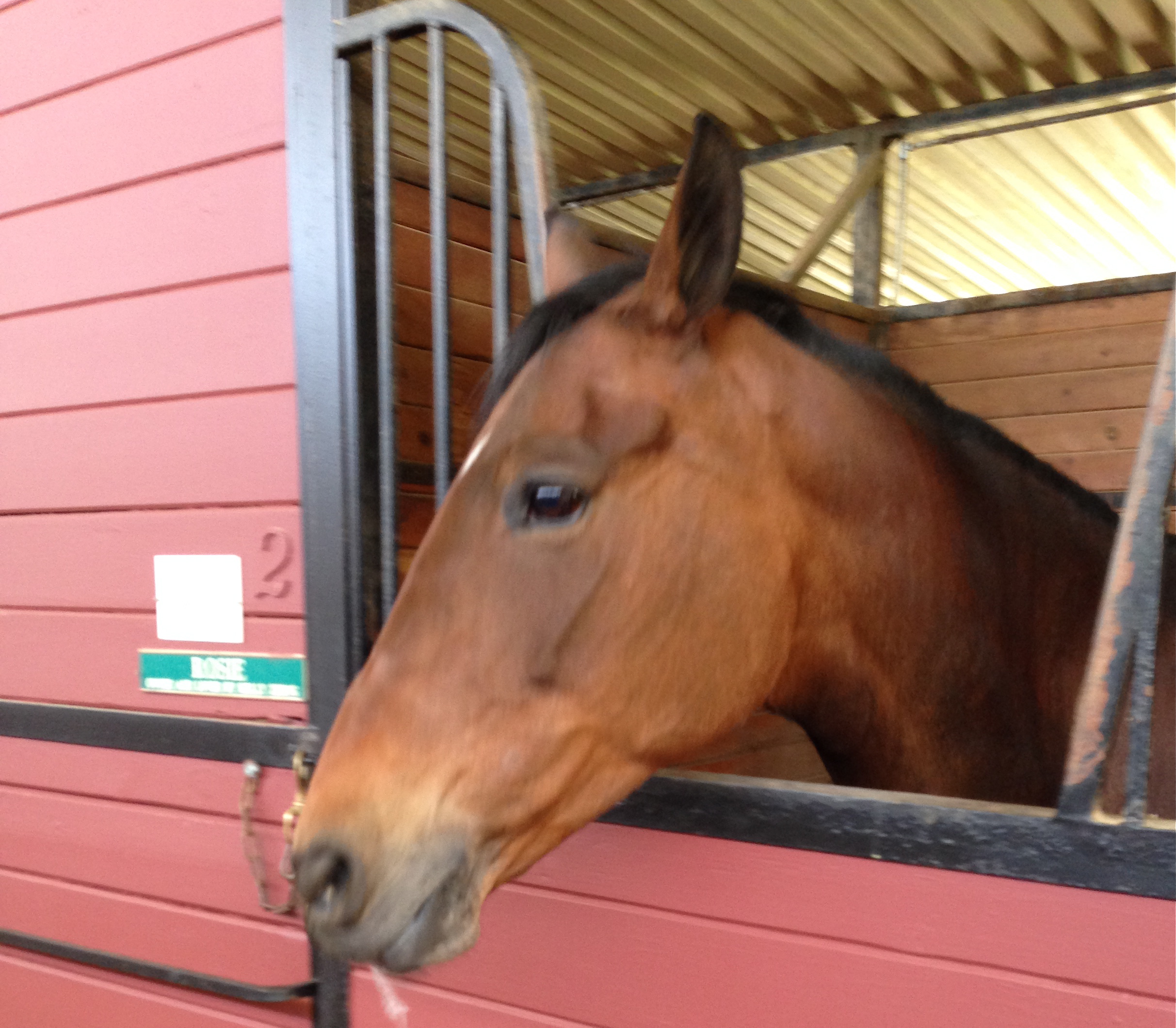
I rode a horse I’ve never ridden before today, named Rosie. She’s a real beauty; a small, bay mare with a sweet face.

IMG_3762I got to the barn with plenty of time to warm up today, and it was a good thing. When I got on Rosie, she was pretty lazy. I haven’t really experienced a horse just kind of refusing to move in a long while. Even my big, lumbering pal Jasper back in Brooklyn would get a move on if you gave him a good squeeze and flapped his reins at him.

At first this got me all in a huff. It is pretty warm today, and I found myself getting worked up about her not even wanting to trot, sweating and breathing kinda hard from the effort. But then I slowed myself down and reminded myself that I do actually know how to handle this behavior. I gave her a couple of “I mean business” kicks to get her going, and then a light tap with the crop whenever she started trying to slow down. It’s amazing how easy it is to forget the basics sometimes.

When I look back, it feels like the first several years I rode were just all about trying to get the horse going and preventing him from stopping. This was back when I was small enough that I probably felt like a fly on the horse’s back and the nickname my trainer gave me was “Noodle Legs” (after a while, she informed me that they had become more al dente). I used to ride this crazy Appaloosa back then named Alvin who would really put me through the ringer. He’d basically mosey into the corner of the ring and stand there, adamantly refusing to move an inch. He’d stolidly withstand my squeezes and kicks and clucks until I was so frustrated I’d be ready to give up. And then my trainer would tell me, “You’re in charge. Make him.” I never really did anything different physically after that; it felt like the same squeezes and kicks and clucks, but they came from a different place, internally. The place where I wasn’t a tiny child asking a big animal to please be nice and do what I wanted him to do, but the place where I was a rider and I was telling my horse it was time to go. And the thing with Alvin was, once you showed him you had that mentality, he’d do anything for you.

With Rosie, it was much the same. She wanted to fool around at first but once I told her what’s what, she picked up her pace. She’s quite a nice mover. Her canter is a little longer and lopier than the ponies I’ve been riding lately but even at faster speeds, it never feels strung out. It’s a smooth, graceful movement with all of her muscles in concert. Maybe part of the perception of her canter being longer is just that she’s actually a horse. With the exception of one ride on Flash and one on Sjapoo, I’ve only ridden ponies at this barn. Bella is in the upper realms of ponydom but I still always feel a tiny bit too big on her, or that I expect her to take bigger, horse-sized spots when it would make sense to wait and add. Rosie is a small horse, probably only 15.1 or 15.2 but that tiny bit more height seemingly makes such a big difference, especially when jumping. Jumping her was fun today, because she was quite willing to go for a bigger spot.

This was most apparent on the line we took at the end of our course. The course was short today; starting with a diagonal cross-rail, to a vertical on the other diagonal and then around the turn to a line. My classmates on ponies were taking it in 4 strides, and another girl riding with us on a giant horse was taking it in 3, so I asked my trainer what she thought would be good for me and Rosie, being in between. She said I could either push for the 3 or try to get a quiet 4, and perhaps the latter would be better. I agreed, but when it came to actually doing it, I found out that the 3 was definitely the way to go. We didn’t jump in huge but immediately on landing I said to myself, “No way is 4 happening here,” so I squeezed her on to the 3, which didn’t feel crazy and out of control, it felt just right. (You can see a video clip of this line on Instagram.)

My mind just felt so different today than it has, so much more stable and strong. At the beginning of the lesson, on a new horse that I didn’t know who was seemingly going to give me a tough time, I felt the old anxiety start to vibrate in my chest. But then I just took control and it went away. I felt more capable on the jumps than I have in weeks and weeks. Even in between them, I felt like I was stretched up taller with my heels further down; I felt so much less sloppy in my equitation. It was like I had all this extra space inside my head, and literally like time was moving slower, so I had time to do things like, you know, breathe and think.

I’m still not used to the higher jumps. The thought of them makes me fluttery inside. But this week, instead of allowing myself to indulge in the gibbering nonsense I’ve been thinking as I stare down at the jumps and flail over them recently, I used my new strength of mind to cut through that with this: “Shut up and look up.”


Challenge!

I rode Bella again today and we did a (for me) very challenging course. We were back in the Big Girl ring again and the jumps were on the higher end of my experience (2’6″-ish, I think, and one was an oxer!).

There were a few challenges with the course, but as seems to frequently be the case with me lately, they were mental rather than physical. My new training schedule seems to be working well, and I feel I’ve trimmed down and tightened up quite a bit. I do always feel a little bit rushed to warm up, especially today when I got to the barn a little later than planned. But even with a quick warm-up at the trot and canter, my muscles seem much more supple than they were even a month ago. I’m going to make it a point to get there a little earlier next time and have a thorough warm-up.

We dove right in with a low vertical on the diagonal to warm up with. I went to it with the confidence of last week’s realization that I have to stop being a control freak and just feel the rhythm more freely with my horse. We took our first two jumps very nicely and even got the flying change afterward, and I was feeling confident and ready for a challenge.

That’s why it felt especially clumsy when we did the course. Basically a figure-eight shaped design, we started on that same vertical on the diagonal (which had a weird approach through all the other jumps), then took the line containing the oxer on the other diagonal, then turned around and took a roll-top on first diagonal, then came over another vertical on the other diagonal again. That’s the best I can describe it; the jumps were haphazardly placed so there was a lot of negotiating obstacles to find the best approach.

My first time through felt pretty disaster-y. Even though Bella was more up and responsive than last week, we still didn’t quite have the right pace for the height of the jumps we were doing. We got in really, really deep to all of them and I was honestly surprised we even made it over some of the jumps. I owe that entirely to Bella, who kept her head and used her athleticism to rock far back on her hind legs and save both our necks.

I also can’t blame this entirely on our pace. I know I was focusing too much on the jumps themselves, looking down at them and anticipating them rather than looking up and through them. It’s new for me to be doing these more challenging jumps and it’s both exciting and daunting (even though I recently read this cute and helpful article on Horse Collaborative). So instead of doing the things my head is supposed to be doing, like counting strides and using its knowledge of how to get flying changes and take turns properly, it’s doing something like this: “Oh ok wow here’s the next jump. It’s high! Holy shit, this is awesome–wait no–god, can I do this? Yes, yes I can. Gotta move her up, let’s go, let’s go…oh, shit, where’s the spot?…aaaah we are in too deep are we gonna make it? Ok yes! Thank you, Bella! Phew. NEXT.”

In between my first and second round, I watched one of my classmates take a fall. She went into the line deep, got a little bounced out of the saddle going to the oxer, and then her horse helped her along by giving a tiny buck afterwards. She was not seriously injured, just a little bruised, but it was a hard-sounding thud when she hit the ground and that’s always terrifying. I had to talk myself down from starting to feel anxious before my next turn, which seemed easier than usual. But then when I went through the course I was still a bit distracted by the fall and wasn’t able to do it much better than my first time.

The third time through, I started to get it. The jumps started coming together better with a little more pace. I had to stop halfway through to re-organize, but that was because of trying to get the flying change in between. I pulled Bella down to the walk, caught my breath, and did the second half of the course in a way I was much more pleased with.

Our last time through was the best. It wasn’t perfect, but it was a vast improvement. We had a good rhythm and the spots came more easily. We only got a little deep on one of them, but it wasn’t disaster-y deep, it was just like a normal added stride that made it not perfectly smooth. I pretty much gave up on trying to get the flying changes by this point and just did simple ones so that I could entirely devote my attention to the course itself and do it well. Given one more go, I think I could have gotten it perfect, but that was a good one to stop on, employing the motto of riders everywhere, “Quit while you’re ahead.”

I was pleased with how the lesson went. It can be alluring to just stay in your comfort zone and feel like you’re doing everything well, but stretching myself and challenging myself is what I’ve wanted to do for so long. When I’m doing it I sometimes feel clumsy or foolish, but ultimately, I feel proud that I’m getting better, little by little. It was also nice to hear from my trainer that she knows she’s pushing me and that it’s tough, but that I’m doing really well.

I’m thinking of trying to go to two lessons a week instead of just the one. Hopefully that will speed up the improvement. The more jumps I get under me, the more confident I become.


Equestrian Fitness: Overtraining, Part 2

cliff

Last week I wrote about the destructive effects of overtraining. I recognized that I was pushing myself too hard and not allowing enough rest in between workouts and this was actually hampering my progress.

In my last post, I put together a new weekly schedule for working out 5 hours a week with scheduled rests. This is what that looked like:

Monday: rest

Tuesday: yoga class (1 hour)

Wednesday: calisthenics/leg and core toning (squats, lunges, crunches, etc) or upper body and core toning (planks, push-ups, crunches, etc)  at home (1 hour)

Thursday: rest

Friday: riding lesson (1 hour)

Saturday: cycling class/upper body weight machines (45 mins /15 mins=total 1 hour)

Sunday: treadmill intervals/lower body weight machines (30 mins / 30 mins= total 1 hour)

Well, none of that happened.

I was actually so shot from overtraining that I ended up taking the entire week off.

The body is so adaptable that it’s very easy to miss subtle signs, or to mischaracterize them. But there were things beyond “normal” tiredness that made me see that I needed a break. Like going up more than one flight of stairs made my thigh muscles feel as exhausted as doing several sets of squats.

So what did I do on my week off? Pretty much nothing. I did some stretching before bed, took some strolls around the park, but that was about it for physical activity. I also made some changes to how I’m eating, cutting sugar (almost) entirely out and adding more lean proteins and vegetables.

The surprising thing is that during that week off, I felt better than when I was working out. I mean “better” in the sense that my body felt leaner, lighter, and tighter–all the things I was aiming for with working out so hard. Towards the end of the week I noticed visual evidence of this as well. The lesson here: the body gets stronger during recovery. Rest is essential.

This is just another part of what I’ve realized is basically my life’s work for myself: finding balance. I’ve written before about my difficulty in finding balance in how hard I push myself physically; between perfectionism and a more lackadaisical approach.

I think where this comes from is a lack of self-knowledge; I don’t honestly know my own limits. Having never tried before to really be an athlete, to make my body the best it can be, I don’t know when I’m pushing myself too hard. I don’t know what is definitively beyond my capabilities and what is simply something I need to build up to. Exercise can be deceptive because in the moment it feels like you can do something and only later when you feel the consequences do you know that you overdid it. Hunter S. Thompson put it best:

The Edge…there is no honest way to explain it because the only people who really know where it is are the ones who have gone over.

After this week off, I see that my body was clearly telling me that I’d “gone over” with overtraining. But where? Exactly how much was too much? Now the only thing to do is slowly wade back into working out and patiently, systematically, try to find that edge so that from there I can find balance–the place where I am training only as much as I need to for performance to be optimal.

Turns and Timing

I rode Bella again yesterday, the small chestnut mare I rode in my first lesson out here. No one else from my regular jumping class was there and the trainer is still out of town at shows, so I rode again with the assistant trainer and two young girls. The lesson turned out to be a good challenge. I brought my saddle along with me and rode in it for the first time in over a decade. It felt really, really good. I asked the trainer her opinion on whether it was too small for me, to which she answered, yes, it is. But not by too much. She said it’s noticeable but not glaring, that I could use a bit larger one but if it’s comfortable for me there’s no reason to run out and get another saddle. I’m going to keep riding in it for now because it is so comfortable.

The interesting thing I’ve noted about riding with this trainer is that she is very structured in her approach. Flatwork is not just a warm-up, it’s a training session that builds individual skills that will be used when jumping a course. In this lesson we really focused on turns and timing.

When warming up at the trot and at the canter, she had us do a similar drill to one she’s had me do before: alternating extending and shortening the horse’s stride. This time, instead of extending on the long side of the ring and shortening on the short side, she had us extend on the short side and rein it back in for the long side. This is a lot more difficult. This drill not only warms up the rider and the horse (all that extending takes a lot of leg and of course the horse is working hard to move that fast), but it’s also incredibly useful for jumping courses, especially lines. When you’re in between the jumps in a line you often need to either move up the horse to take away a stride or pull them back to add a stride, and this exercise builds those skills on the flat. It teaches you how to get that extension out of your horse by squeezing with your legs and how to get them to come back by sitting deeper in the saddle and using your back and hands. It also trains the horse to be responsive to those aids and flexible in changing her stride.

The next drills worked on turns. This trainer is big on circles, really emphasizing pushing the horse out with your inside leg while keeping her moving forward and on track with the outside leg. There’s a huge temptation to use your inside rein to get the bend; it turns the horse’s head and should be used subtly and indirectly to help create that silhouette. But when you’re thinking about jumping a course with some tight turns in it, you don’t just want to be wrenching your horse’s head towards a jump at the last minute. That will prevent you from coming in straight and will likely earn you at best a knocked-down rail and at worst a flat-out refusal. Instead, you want to be prepping your horse for the turn with your seat as early as possible–on the landing, if not in the air. To that end, we did two really useful exercises before jumping a course. The first was not dissimilar from one I’ve done with her before, doing a circle around different points of the ring with a focus on bending. But this time she upped the ante and took away the ability to use the inside rein at all; we had to take both reins in our outside hand and get the circle and bend entirely with our legs. This was hard. Imagine sitting on a bike and trying to make it go in a circle without touching the handlebars. And then imagine that the bike is 2,000 pounds and has a mind of its own. Pushing the horse out with your inside leg is so much work. Think of how much effort you have to put with your whole body into pushing a heavy piece of furniture; this is like that, but just with one leg.

After that, the trainer set up some poles on the ground. There were two in the middle of the ring at the longwise center line and then two perpendicular to that on a tight turn–one to the right and one to the left.  It looked kind of like this crappy drawing:

polesWe had to canter in over the two center poles and then make the tight right turn to canter the right pole, then come around and go through the center poles again to make the tight left turn to the left pole. The turns were very tight. The first time it took all of us by surprise and everyone did that last-minute jerk on the reins that made a very messy, bowed-out turn and did not get a straight approach. The trainer illustrated what needed to be done in a really helpful way though (to me at least, but not really to the two little girls): she asked if I’d ever driven a truck. I said I have, and so she likened turning the horse to turning a truck; you always have to go a little bit further out in turning the front end of it in order for there to be room for the hind end to get around the turn and come in straight. So the next time through, more prepared, I did much better; I set my horse up right after the center poles by switching my weight to the outside stirrup and pushing the horse over with the inside leg.

The course we did at the culmination of the lesson was set up to be all about turns. It started with a line on the long side, then went to a line across the diagonal, then a tight turn to a single jump on other diagonal and then around another tight turn to finish off over two poles. Like this:

course It went pretty well. I was so focused on making my turns well that I got a little messed up about my spots. This was another situation where I needed to sit back and wait; Bella knew where she needed to take off and it was a stride closer than I expected her to. I have a tendency to sort of throw myself forward in the saddle; it’s almost like I’m trying to jump for both of us. It’s something I really have to work on, for two reasons. The first is that if I’m flinging myself forward and my horses refuses, it’s curtains for me. I’m going to go over her head. The second is that it’s totally counterproductive to my horse. When a horse jumps, the power all comes from the hind legs for the take-off, so she needs to somewhat rock back on her hind legs first. If the rider is ahead of the motion of the jump and her weight is forward over the horse’s neck, it makes that movement so much harder. Jumping position should happen over the jump, coming up to meet your horse’s neck and arched back, not before take-off.

I would have liked to keep perfecting the course longer, but we only had time to do it twice. It’s very useful to build up skills dong all of these flat exercises and I’m glad for the experience, but there are drawbacks, like not having a whole lot of time for actual jumping and also being pretty fatigued by the time we get to it. Hopefully next week I’ll get a chance to focus more on courses and take a break from all this intense flatwork.

________

To top off a good riding lesson and make the day extra horsey and wonderful, I also got to go watch some show jumping. My boyfriend and I went out to the barn in Burbank where they were having a competition and it was very nice. There weren’t many spectators, so we got to be right up close to the action. I don’t honestly think I’ve ever been this close to a horse jumping so high; the fences in the class we watched were 69″ (or 5′ 9″–three inches taller than me). I’ve seen it from far away in a grandstand and I’ve seen it on TV, but when you’re up close it really drives home the athleticism of these animals. You can feel the presence of such a huge body and the exertion of it leaping into the air carrying a person on its back. It’s pretty unreal. And exciting and beautiful, as well. Watching the riders take the course, I paid particular attention to their turns and found it to be very predictive. It was easy to see when someone was going to knock a rail down and almost all of the time it was because of a bad approach due to lack of a good turn. That’s way easier to see when you’re in the stands than it is when you’re down in the ring, especially since show jumpers don’t get a practice round. There’s no opportunity to see the course from horseback prior to entering for your round, there’s only a walk-through where riders and trainers apprehend the course on foot. If I ever get a chance to ride in one of these shows (and I want to, now maybe more than ever), I’m definitely going to keep that in mind on my walk-through and pay close attention to looking at where I’m going to make my turns.

showjump
A rider (not me) at the show jumping competition.


Equestrian Fitness: Upper Body

It’s obvious that in order to be a strong rider, you need to strengthen your core and your legs. But what about upper body? It seems like this is an area that riders–and women generally–tend to neglect in their fitness routine.

I’ve found, mostly by accident, that a strong upper body improves my riding in so many ways. I would go to the gym and do a bunch of lower body exercises: running, squats, cycling, and all the thigh-oriented weight machines. Those have all done great things for me and I’ll touch on them in another post. But I realized that if I was going to be all-over fit, I had to target the rest of my body too. My original goal was to lose some weight and to look a bit more toned. The rationale was that muscle burns more calories so putting more muscle everywhere on my body that I could would speed up the burn.

I think a lot of women avoid the upper body weights area at the gym for two reasons: 1) not wanting to look like a dude and 2) dudes. To address the first, I’ll say this: you won’t. Unless you’re taking steroids (which, just don’t) then your feminine form is safe; lifting even heavy weights is not going to make your arms muscled like a man’s. As for the second, it’s true that the free weights area is an especially testosteroney zone in the gym. For some reason the guys are all really hyped up over there about each other and there’s a whole lot of posturing going on that only gets worse when a girl is thrown into the mix. At first it really put me off, but I’ve learned to just ignore it and laugh about it in my head. I’ve found that the weights machines are a little less fraught and seem to have a more reasonable male-to-female demographic if that makes you more comfortable. Plus, if you’re just starting out, one benefit of the machines as opposed to free weights is that your movements are constrained and guided by the machine and you might be less likely to hurt yourself overextending your range of motion.

It might be tempting to go for the more simple-looking machines that target the familiar small muscle groups like the biceps and the triceps, but we’re going for more than just toned arms here. The goal here is to strengthen the chest and the back for better equitation posture, better airflow, and more control of your horse. Also, most of the machines that target these bigger muscle groups also work the smaller secondary ones as well, so you’ll still end up with nicely toned arms.

Historically, I have had pretty much zero upper body strength. On top of that, the tone I do have is completely lopsided; since it comes mostly from pitching softball for nearly a decade, I have this disproportionate right bicep that looks really big compared to the left one, but which really provides no strength since none of the other supporting muscles are strong.  I can do zero unassisted pull-ups at this time. I can do a decent amount of push-ups (20-30) if I am balancing on my knees, but can barely do any (maybe 3-5 on a good day) if I’m in full plank/push-up position. My back is a particular weak spot, having hunched over a desk forever. So there’s a lot of work that can be done.

My approach has just been to browse through the machines and keep trying new ones that look interesting. There’s a little diagram on each one that shows which muscles it targets and a few instructions on setting it up to your size. I make a guess about how much weight I think I can lift (sometimes based on checking out whoever used it before me) and make adjustments if necessary. I lift the heaviest amount of weight I can handle for 6-8 reps and do three sets of that. I used to do the opposite, putting the weight relatively low and doing a lot of reps because I thought I was going for tone and that’s the way most women go about it. But I’m going for strength and since I’ve started doing it this way I’ve gotten much better results.

Variety is a good thing here; before I had just a couple of machines that I was comfortable with and stuck to those but it’s important to branch out. I want my whole upper body to be shored up with muscle so that when I sit up tall in the saddle, it’s like a framework that already exists and I don’t spend mental and physical energy holding myself up all the time. I noticed a difference right away in my lessons. My posture was much more upright, my shoulder blades much more supple and able to support and open up my chest. My mid-back was much more still; I didn’t get pulled forward as easily by my mount tugging on the reins or being heavy on the forehand and I didn’t rock so much in the saddle at the canter.

So I keep trying as many of the different machines as possible to get an all-around strength. It’s important for creating that balance and harmony among the whole muscular system; you don’t want one thing to be really strong and another part of be really weak because it will pull you out of whack compensating for that. A good tip my boyfriend told me was that if you work a muscle by pulling, then you should also do the opposite motion and work it by pushing. (Think of the thigh adductor and abductor machines, aka “the inny and the outy” in my nonsensetalk language; the one where you use your inner thighs to push the pads between your knees together and the other one where you use your outer thighs to push the pads between your knees apart.)

That being said, here are a few of my favorite upper body machines specifically for building strength for riding:

1) Chest Press: This is the one where you sit and use the handles at chest height to push out until your arms are extended; it’s basically like a seated push-up. This has made the biggest difference in my posture of any exercise I’ve done. Opening and lifting the chest is one of the most important visual components of having perfect-looking equitation but there are a lot of practical reasons for that. Firstly, you can breathe a lot easier, giving you much more stamina for keeping that slowpoke horse from breaking or having enough air to get you through that long course. Second, it gives you better balance in the saddle, reinforcing that line we’re supposed to keep from shoulder to knee to ankle. If your chest is caved in and your back is rounded that throws the weight of your head and neck forward and down and limits the effectiveness of your seat. Thirdly, what follows naturally from having better balance in the saddle is your horse having better balance and you having more control. When you sit up with your chest open, your head and your hands come up and that brings your horse’s motion up as well. With an open chest you have so much more strength for sitting up to give your horse half halts to gain a little control, to enact smooth downward transitions and stop the horse completely, or even to stay on if he decides to buck. Finally, a strong chest will help you keep yourself lifted in jumping position so you don’t collapse on your horse’s neck on the landing. An added bonus of the chest press is that it works the triceps as well which will help you to pull back from the elbow on those reins. Another machine that also works the chest and triceps in a slightly different area is the Chest Fly, I like that one a lot, too.

2) Mid-row: This is the balancing movement to the chest press, working the middle of your back just below the shoulder blades. This will help your posture in all the ways described above, working in concert with your chest muscles. Sometimes I do the weight machine with this motion and sometimes I switch it up and do the rowing machine that simulates a row boat, where you put your feet in the stirrups and push with your legs while pulling on the row bar. That one is good because it also works your legs and adds a cardio component, but the resistance is lower than you can get by using the weight machine.

3) Lat pulldown: This works more of the upper shoulder blades and also the muscles down your spine to your spinal erectors. It will help create that framework I talked about earlier of holding up your entire upper body. It also works your biceps, which is a good counterpart to the tricep strengthening of the chest machines.

Finally, since this was an area where I’ve felt especially weak, I’m incorporating a daily challenge at home to really push myself. I’m doing this 30 Day Plank Challenge. To really get results quickly, I’m not only doing the one shown in the picture where you rest on your forearms; each day I’m also doing a full plank with arms extended and a full side plank on each arm.  This is great because it not only boosts your upper body strength, but works your entire core.

If you’re looking to increase your strength as a rider, don’t neglect your upper body! In equitation there are so many things to keep track of in your own position in addition to controlling the unpredictable 2,000 pounds beneath you. The only way I’ve found over the years to keep it all together is for some things to become second nature and drop from my immediate consciousness to free up space for what’s going on in the moment. I call this “dropping below the line.” Theoretically, it would be ideal for all considerations of position to be below that line and for perfect equitation to be instinctual. For years now, my upper body has been “above the line,” a constant focus and something my trainer often has to remind me of. Strengthening these previously-neglected muscles and creating a framework for my upper body has allowed me to drop that part of my position below the line of consciousness and frees me up to become a better, more present rider.


Fitness

My lesson yesterday left me pretty sore so this morning instead of going to the gym, I’m in recovery at home. When I’m tight and sore, the natural response is to not want to move at all. But I’ve learned that “recovery” is not simply about doing nothing–rest is important, but so is stretching and moving in a way that will help those muscles heal.

This morning while doing my own version of recovery–some light yoga and using these amazing things to work out the really painful kinks–I was thinking about my own fitness regimen. I’ve read many articles and blogs talking about the best exercises to get you in shape for horseback riding. All-over muscle tone, but particularly core and leg strength, is usually the focus. Clearly, the best way to develop riding strength is to ride often. But I’m finding that there are certain exercises that develop enough tone to make my lessons much more productive; having that “head start” of some tone in the muscle helps those parts of my body warm up more quickly and operate with more suppleness in the lesson, which in turn probably leads to building the muscle more quickly.

I thought I’d share what I’m finding here–basically through trial and error–in case it’s helpful for anyone else. The fitness regimen I’m trying to establish is not only for riding, although getting back into the best shape I can for that is one of my main goals. I’m also realizing how important fitness is as a part of life. I’m at the age where during the next several years, muscle tone will start sharply declining and I want to head that off at the pass as much as possible so I can continue leading an active life. Putting the work in now is setting me up to include fitness as a major part of my lifestyle for the rest of my life, and I need that.

As a child I was incredibly active. I was naturally athletic, energetic, and thin. As I’ve aged, my metabolism has changed and I’ve accepted that as a natural part of aging. I’ve continue to consider myself “active” since compared to most people, I was. I walked a lot. I played softball twice a week for half the year. I rode horses every other week. I tried to make it to the gym once or twice a week for a run on a treadmill and some weight-lifting. I occasionally rode my bike around the track in the park a few times. As I type that now, it sounds like a lot. But it’s not. At no point in any of those activities did I really consistently push myself.

In the last three to four years, I put on what for me was a lot of weight. Part of this can be attributed to turning 30. Part of it can be attributed to sitting in a dim hole of a cubicle without seeing a window for the better part of a year and my Seasonal Affective Disorder getting out of control. Much of it can be attributed to a great deal of stress from a variety of sources. I looked ok. I was still “thin” by most people’s standards, and my friends mostly told me to shut up because I was fine. But I didn’t feel fine. I felt like I wasn’t myself, like the body I was inhabiting wasn’t even mine. And a huge part of what felt integral to my personality–my ability to be active–was slipping away. Fatigue, muscle aches and worsening headaches became the norm rather than the exception. I started to become depressed at the thought that I’d never be able to feel energetic and healthy again.

Since moving out to LA about a month ago, I’ve gone to the gym almost every day. It’s a lot more accessible to do so, since I just hop in the car and drive for about 5 minutes to get there, instead of negotiating bringing all my gym clothes to work and convincing myself to get off the subway a few stops before home to walk several blocks in the cold to work out. The gym here also costs me about $40 a month less than it did in NY while at the same time being much nicer and having more equipment, classes, and amenities.

After this month of working out, I’m starting to feel a little bit better. But really, I’m just scratching the surface. It’s made me realize how much damage has actually been done by the complacency of my sedentary lifestyle. I realize that because fitness came so naturally and easily to me as a child and a teenager, I’ve expected it to be that easy as an adult. And it’s not. It’s hard. If I want the level of fitness and athleticism that I had before, I have to really, really push myself to get it.

I’ve also realized how important that is to me. I think there’s a kind of shitty peer pressure pervasive in our culture to not make fitness a huge priority because if you do, it makes the people who don’t feel bad about themselves. There’s the stereotype of an image-obsessed “gym rat” chick who is trying to get impossibly skinny, or the musclebound meathead guy who can’t put his arms down. The fitness world certainly does have its own particular breed of psychosis (as does every sort of niche); I’ve seen some of that here and I don’t even live in the really crazy part of town. But as with everything, balance is key. Pushing your body to freakish proportions is unhealthy and so is neglecting it entirely.

So, going forward in addition to my weekly lesson post, I’m going to also write about my adventures in getting in shape. I’ll mainly focus on what works and doesn’t work for me as a rider, since that’s the topic of this blog, but obviously there will be overlap on what just works generally. I want to become the best rider that I can be–I’m curious as to how good that really is when my body is also the best it can be.

Last Lesson

Today was my last lesson at Jamaica Bay.

I’ve been planning a move for some time now, and it’s finally happening. At the end of the month, I’m going to get in a car and drive to California, like I’ve been pretty much saying I was going to do on and off since about 2002.

It’s no secret that there are few things I will miss about New York City, especially in winter. It’s inhospitably cold, it’s oppressively crowded, it’s exorbitantly expensive, and it is very difficult to do most of the things I love to do here. But there are some things I will miss dearly: my friends, my softball team, and riding with my Riding Buddy at this barn.

This isn’t the first time in my life that my riding lessons were one of the only things keeping me sane; I don’t imagine it’ll be the last. But whatever else was going on in my life, every Saturday when Riding Buddy would pick me up in the car, I’d feel so relaxed and happy, chatting with her about our lives: our jobs, our relationships, our attempts to get on a regular workout routine, horses, and books. I still feel like there was something cosmic in our meeting, our riding history and circumstances–and even our birthdays!–being the same, and both of us finding our way back to horses at the same time. At first I was just so pleased to have someone to share my lessons with, to share the craziness at Kensington with, and to share a Zipcar with. But she’s turned into more than just an activity partner and has become a true friend. We cheer each other on, we helpfully critique each other, we rehash the our lessons on the way home. I’m going to miss riding with her so, so much.

I’m also going to miss Jamaica Bay terribly. Having so recently begun riding with our new trainer, Jess, it’s such a disappointment to have to leave. She’s the best trainer I’ve had as far as being so engaged with us, being so knowledegable and fun and understanding, and being so aligned with my philosophy of riding. So many of the people at the barn have been so friendly, and I’ve come to feel like I belong there and am known there. And I will, of course, miss the horses. Jasper and Summer, and Misfit and Sparkling Gal. For all their quirks, they are some of the nicest schoolies I’ve had the pleasure of riding.

Part of me had hoped to ride my favorite, Jasper, for my lesson today, but it wasn’t in the cards. Instead I had a very rewarding, wonderful ride on Misfit. I think in the long run, leaving on the high note of having a great lesson on a more challenging horse rather than one that I love because I’m so comfortable with, is a better way to go. After last week’s lesson on her and then another great ride today, I feel confident and strong.

We lucked out on weather today and as a special treat got to ride outside. There was a cold breeze but it was warm enough in the sun, and it’s always easy to keep warm between the exertion of riding and the horse’s body heat beneath you. Misfit was perky and looking around a bit at things, but steady. I talked soothingly to her as we went down to the far end of the ring, by where the tall cattails sway. I looked out over the edge of the wetlands that begin there and remembered how calm and beautiful it is to trail ride there, wishing I’d done it more often.

The lesson was everything I could have hoped for. Before I left my house, I was having to remind myself to get out of a perfectionist mindset, to not heap so many expectations on this lesson to be a certain way just because it was the last. But it was great. We got to jump a bit more because we were outside, and I didn’t have to worry about landing on any little children. Misfit and I found a good rhythm together and pretty much all of our spots felt just right. I felt a small tingle of nervousness when our trainer suggested we put a couple of the jumps together for a mini course; there was a stiff, cold breeze and I worried for a moment that Misfit would get fast. But she didn’t. She was there with me, listening to my hands and my seat and my voice. We took a small solid jump at an angle and then went around the ring to do a line. She came right back to me in between, steadying and getting the four strides. Lately after jumps I’ve been immediately concerned with pulling my horse back down from the canter, I suppose mostly because there’s not much room to canter away in the crowded indoor. But after that last line, Misfit cantered away so beautifully that I decided to just let her go. We floated on in a big circle around Riding Buddy and my trainer that I called my “victory lap,” Misfit moving effortlessly and me riding in a half seat and patting her neck all the way.

For all that I’m sad to leave and know I’m going to miss here, what I am gaining right now is worth it. I’m leaving the place I’ve lived for ten years, and the general region that I’ve lived in my whole life. For a long time now, that lack of mobility has not felt settled or comfortable. Living here has always felt temporary, and as time stretched on where I felt a desire to move on and a seeming inability (due to jobs, relationships, etc.) to do so, it began to feel like a trap. I was filled with a dread of the uncertainty of life because the uncertainty in question was whether I’d ever be able to break out of that trap. With this move, I am facing a great deal of uncertainty. I don’t know what it will be like in LA, whether I’ll stay there or move somewhere else, what my professional life will look like as I continue to try to make change in that…but this uncertainty doesn’t fill me with dread. It’s exciting, and galvanizing and makes me feel like I’m finally, in a way, beginning my life.

I do know that one of the first things I will do upon arriving is to look for a new barn. It’ll be tough to go without my Riding Buddy, but maybe in some ways it’ll be good, too. LA is still an urban environment, but it’s the sprawly kind, not the concentrated-on-one-tiny-island kind. That comes with its own set of problems, but space isn’t one of them. I’d imagine there will be more opportunities and more room to ride. And with the lovely weather out there, no more being stuck in a crowded indoor.

I’m excited to see what this next chapter brings, in my life and in my riding. I’ll continue to chronicle it here, although I’m not sure when I’ll next get a chance to ride. Hopefully soon!